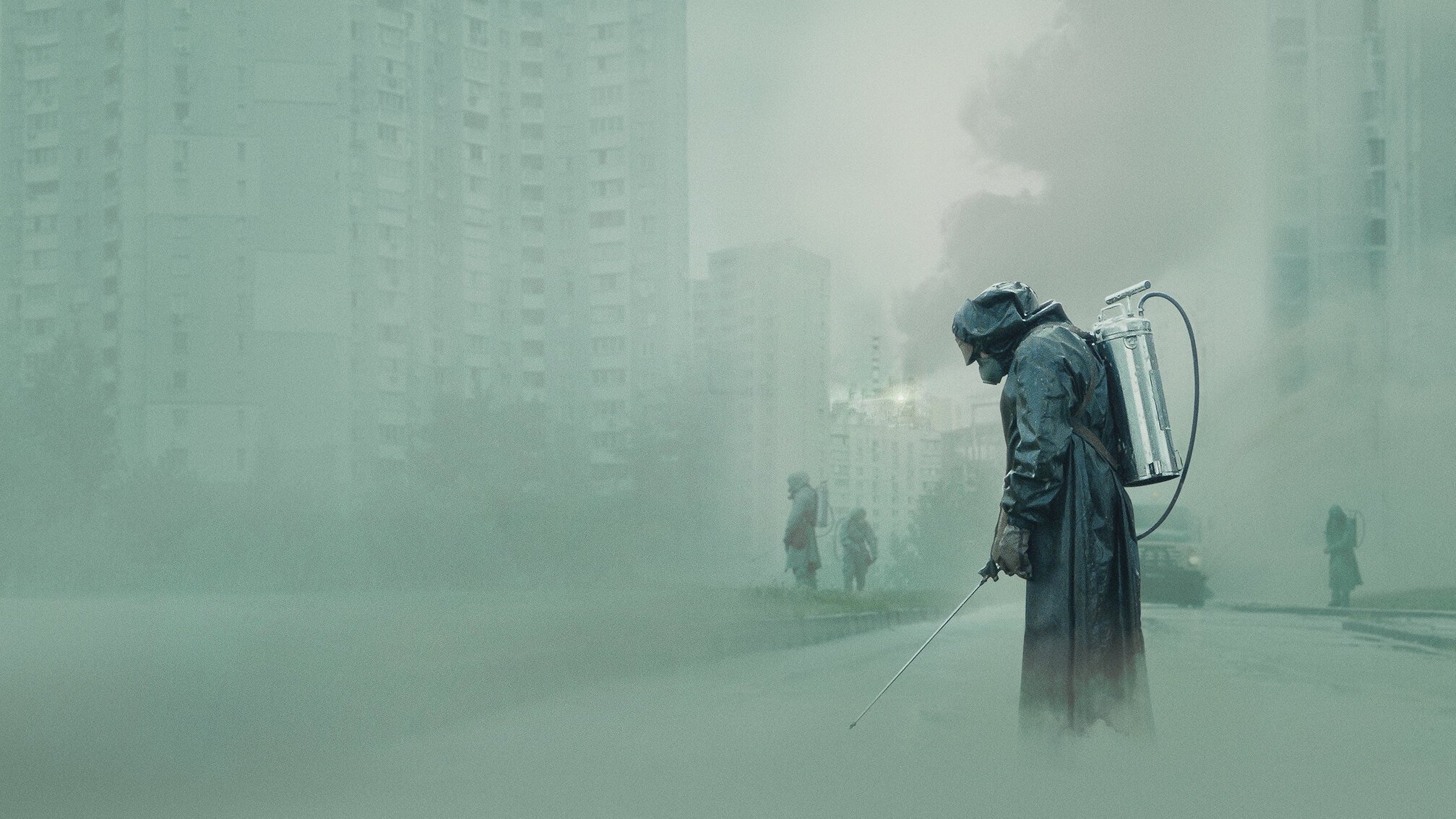
Chernobyl

There aren't many times when a television series manages to completely captivate you without relying on shocking twists, spectacular action sequences, or expensive visual effects. Chernobyl accomplishes something far more difficult: it transforms a story we all already know into one of the most intense and suspenseful television experiences I've ever had.
From the very first episode, you already know how it ends. You know the tragedy, its consequences, and its place in history. Yet every single episode keeps you on edge because it doesn't simply tell you what happened—it puts you there. Inside the corridors of the power plant. In the hospital rooms. In the meeting halls where people had to choose between telling the truth or protecting the system.
And that's the series' greatest achievement.
Most disaster stories have a clear antagonist.
Chernobyl doesn't.
Radiation has no face. It makes no sound. It gives no warning. It doesn't chase anyone. It's simply... already there.
That creates a level of tension I've rarely experienced elsewhere. Every step a firefighter takes, every piece of metal someone touches, every second spent near the reactor suddenly carries enormous weight. The audience knows something that most of the characters don't, making the experience almost unbearable.
The series doesn't rely on jump scares.
It builds fear through knowledge.
If I had to summarize Chernobyl in a single word, it would be responsibility.
The explosion was only the beginning.
The real story is everything that followed: denial, bureaucracy, the fear of admitting mistakes, and the constant conflict between science and politics.
The series doesn't try to paint simple heroes and villains. Instead, it shows how an entire system can push ordinary people into making tragic decisions.
That's what makes it so timeless.
Its message isn't just about the Soviet Union in 1986. It's about every society where appearances become more important than the truth.
Jared Harris is phenomenal as Valery Legasov. He doesn't need dramatic speeches or theatrical performances. A single look is enough to convey the burden carried by a man who knows that whatever choice he makes will come at an enormous cost.
Stellan Skarsgård delivers what is arguably the series' most fascinating character arc. Watching Boris Shcherbina evolve from a rigid government official into someone willing to confront reality is one of the finest examples of character development I've seen in a limited series.
Emily Watson, despite portraying a composite character representing numerous real-life scientists, perfectly embodies the voice of scientific reason standing against political pressure.
No one tries to steal the spotlight.
The true protagonist is the story itself.
One criticism often mentioned by reviewers—and one I completely understand—is that Chernobyl demands your full attention.
The dialogue is dense, the scientific terminology can be challenging at times, and its deliberately slow pacing may test viewers expecting faster storytelling or more action.
Its relentlessly heavy atmosphere also offers very little emotional relief. Personally, I never found that to be a problem, but I can certainly understand why some viewers might find the experience emotionally exhausting.
Finally, while the series is remarkably faithful to historical events, several historians have pointed out that it simplifies or combines certain people and events for dramatic purposes. That's perfectly understandable from a storytelling perspective, but it's still worth acknowledging.
One detail I found particularly interesting during my research was learning that most of the series was filmed in Lithuania, using the real Ignalina Nuclear Power Plant as its primary location because its reactor design closely resembled that of Chernobyl.
Another surprise for me was Craig Mazin himself. When he was first announced as the creator, I honestly wondered how it could possibly work. Up until then, he had been known primarily for writing... comedies. Chernobyl proved just how versatile he is as a writer, something he would later reinforce with The Last of Us.
Composer Hildur Guðnadóttir recorded much of the soundtrack inside real industrial facilities, using authentic metallic and mechanical sounds instead of a traditional orchestra.
The creators also worked closely with scientists, historians, and survivors to ensure the events were portrayed as accurately as possible.
The series went on to win 10 Primetime Emmy Awards, including Outstanding Limited Series, and is now widely regarded as one of the greatest television productions ever made.
For me, Chernobyl isn't simply one of the greatest miniseries ever created.
It's a history lesson, a human tragedy, a political drama, and an extraordinary achievement in television storytelling all at once. It never relies on spectacle or cheap emotional manipulation. Instead, it trusts the truth, its characters, and the atmosphere it creates.
And ultimately, that's what makes it so powerful.
It doesn't leave you remembering the explosion.
It leaves you wondering how easily an entire society can collapse when the truth becomes more dangerous than the problem itself.


