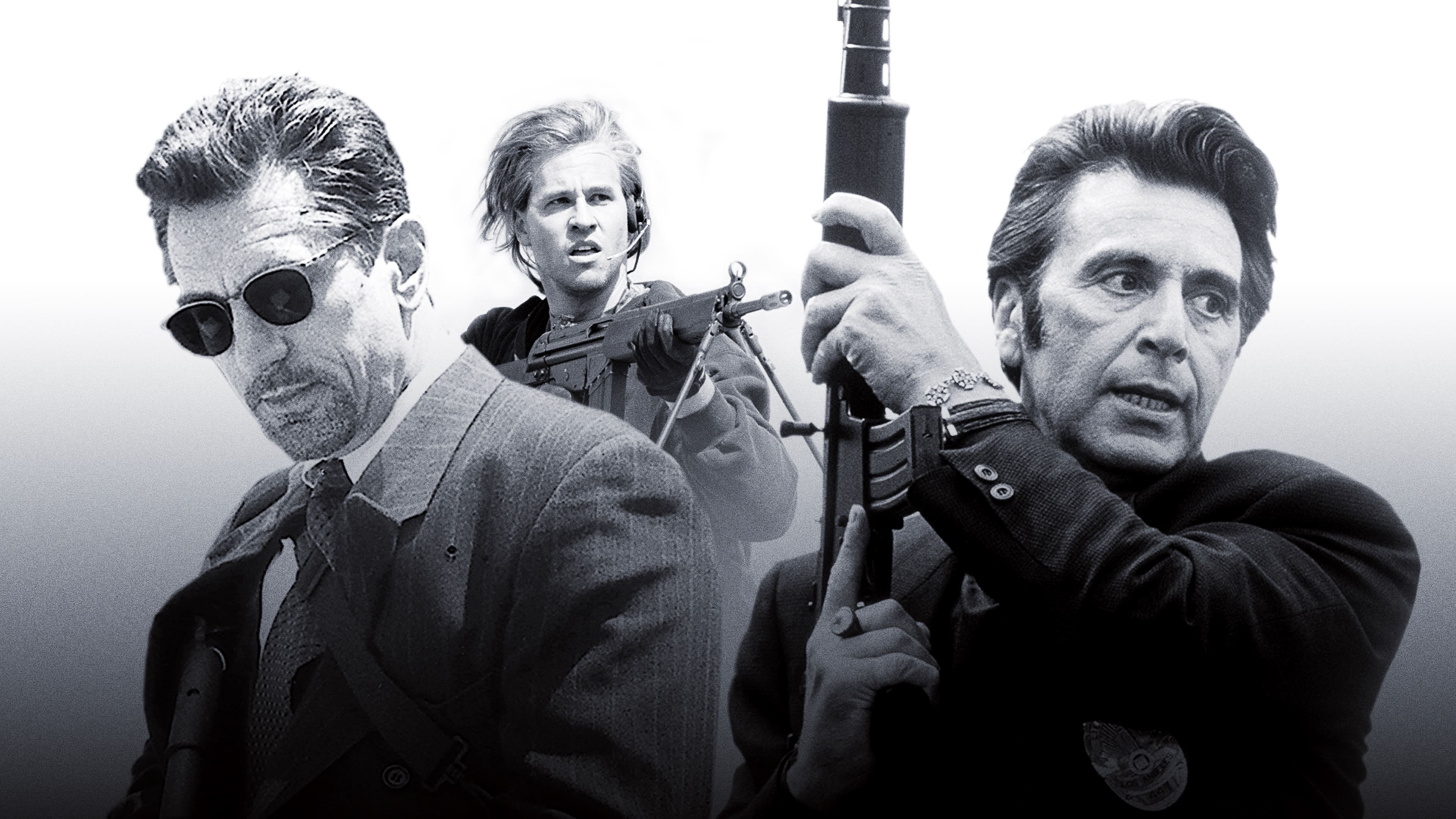
Heat — Η πρώτη μου φορά στον κινηματογράφο

I can still remember the robbery and the exchange of gunfire through the streets of Los Angeles. The sound inside that cinema was so immersive that you felt like the bullets were flying right past you.At some point, Nikos couldn't take it anymore. He jumped to his feet and shouted:“WHAT THE FUCK ARE WE WATCHING, GUYS?”The answer came immediately from the back rows:“SIT THE FUCK DOWN, YOU MORONS!”And just like that... order was restored.
I was 16 years old. At that time, there were still age restrictions in Greece for quite a few action movies. I don't know if it was the same in your country — my articles are always translated into English too — but back then, if a movie had a lot of gunfire, blood and violence, you couldn't exactly walk into the cinema easily if you were underage and unaccompanied.
And you know something? When you're 16, you don't go to the cinema with your parents. You go with your friends. Friday night, because Saturday was reserved for other outings. Walking to the bus stop, taking the bus to Glyfada — with a ticket or... without one, let's not get into that! — and then walking a little more until we reached the cinema. I mention all this because today almost everyone drives everywhere. Back then, though, the journey itself was part of the night.
Usually, bowling at the legendary Blanos came afterwards, for those who grew up in Athens, or maybe a game of pool, although I was never particularly into it. The night didn't end when the credits rolled. That was when the endless discussions about the movie began.
First, though, we had to get past the... entrance.
And that's where the negotiation began.
There was no giant bouncer like the ones we would see at clubs a few years later. Usually, it was some older man who worked at the cinema, perhaps the owner, somewhere around sixty-five or seventy, trying to decide whether it was worth taking the risk. If he let us in, he could get into trouble with the police or, even worse, with some mother who would come knocking the next day to give him hell, after first having stretched her kid's ear out like Tiramola.
And of course, we had our own strategy. The classic sixteen-year-old attitude, trying to convince everyone that he was already eighteen.
“What are you looking at? I'm eighteen!”
I don't remember whether they stopped us that day and we had to negotiate, or whether we simply walked in with that wonderfully blasé attitude you have at that age. What I do remember is that... we got in. All of us.
And then the magic happened.
The lights went out, the auditorium disappeared into darkness and the smell of popcorn filled the room. Maybe that's why popcorn is still part of the playview.eu logo to this day. For me, popcorn and the cinema have always been inseparable.
Cinema, though, was never just about the movies. It was about the friends, the laughter, the walks and, let's be honest, sometimes the fact that the darkness was quite helpful when your first crush had already started knocking on the door. But those are stories for another chapter.
Back to Heat.
And what a movie to start with...
One of the best action movies I have ever seen. Robert de Niro and Al Pacino at their absolute best, in a historic meeting that became part of cinema history. I can still remember the robbery and the exchange of gunfire through the streets of Los Angeles. The sound inside that cinema was so immersive that you felt like the bullets were flying right past you.
At some point, Nikos couldn't take it anymore. He jumped to his feet and shouted:
“WHAT THE FUCK ARE WE WATCHING, GUYS?”
The answer came immediately from the back rows:
“SIT THE FUCK DOWN, YOU MORONS!”
And just like that... order was restored.
But let's get to the movie itself!
The real Neil McCauley, played by Robert De Niro in the film, was a professional criminal and former Alcatraz inmate who was being investigated by Chicago police officer Chuck Adamson. Michael Mann didn't create Neil McCauley out of thin air. The story has a real-life foundation and, in fact, Adamson became a major inspiration for Vincent Hanna, played by Al Pacino.
Even more interestingly, the two real men once met for coffee (!!!), just like Hanna and McCauley do in the movie. Their real-life relationship essentially became the core of Mann's idea.
Mann had been working on the story for years. The Academy, you know, the Oscars people, notes that the earliest drafts of the screenplay date back to 1984. Before it became Heat, the story went through different forms and eventually became the 1989 television film L.A. Takedown.
The interesting part is that Mann felt the television version had not managed to fully achieve what he really wanted to say, so he returned to the story and transformed it into Heat. The movie version, then, wasn't an idea that suddenly appeared in 1995. It was a story Mann had been carrying with him for more than a decade.
Pacino vs De Niro
You remember them in The Godfather, right? You do? Well, mostly separately, because guess what... they never had a scene together!
Heat was the first time the two actors were actually opposite each other, in the same movie and in the same scene. And Mann used that brilliantly, because he didn't put them together immediately. He builds anticipation for a large part of the movie until we finally get that famous coffee-shop scene.
There is also the story that De Niro suggested that they not rehearse before the scene, so that the first encounter between the two characters would feel as natural and authentic as possible, something Mann agreed with. And perhaps that decision helped make the scene feel less like a cinematic “event” everyone had been waiting to see and more like a real meeting between two people who immediately recognize something familiar in one another.
Because Hanna and McCauley aren't simply opponents. They are two men who have become who they are because they have devoted their entire lives to their work. Neil and Hanna are morally opposite, but psychologically, they are almost the same.
Think about Neil McCauley: absolute discipline, professionalism, control, avoidance of emotional attachments and, above all, the job. He has built his entire life around a code that tells him never to let anything hold him back.
And opposite him is the great Al Pacino as Vincent Hanna, with his obsession, his intensity, his inability to disconnect from his work and his personal life gradually falling apart because of that obsession, along with his need to chase an opponent he recognizes as being on his level.
And this is where the great irony of the story lies: McCauley and Hanna need each other to confirm who they are. One cannot stop stealing, and the other cannot stop chasing.
And then there's the sound...
Mann didn't simply add the gunshots later in a studio and say, “Okay guys, make it go a little more boom here.” For the famous shootout, microphones were used in the area to capture the real echoes of the gunfire through the streets of Downtown Los Angeles.
That's one of the main reasons the scene has that strange, enormous acoustic quality. Remember when I said earlier that the bullets felt like they were flying right past you? And we didn't have IMAX back then, let alone Atmos! This was part of Mann's intention, to make the audience actually feel the sound that way, and for me, that's one of the most incredible aspects of the movie.
At 16, of course, I had no idea about any of this. All I knew was that when the shooting started, the cinema suddenly felt smaller and the bullets seemed to be flying right past our ears.
And here's another detail that shows just how seriously Mann took the effort to make McCauley's crew look like real professionals. For the robbery sequence and the weapons work, the production brought in former British SAS soldier Andy McNab as a technical adviser. The actors went through approximately three months of training, so that their movements, the way they handled their weapons and the way they moved during the shootout would look as realistic as possible.
Mann wanted the people we saw on screen to look like they genuinely knew what they were doing, rather than actors who had simply learned a few moves for an action sequence. And the result was so convincing that footage from the movie was later used as training material for U.S. Army personnel.
Not bad for a group that started out planning a bank robbery!
And I can't forget the rest of the cast
Because this really is an ensemble, not simply two enormous names at the top of the poster.
Val Kilmer as Chris Shiherlis, is much more than “the guy from the crew.” His relationship with Charlene shows a man trying to balance his work with his family, except the job he has chosen leaves him very little room for a normal life. Charlene wants to protect him, but at the same time she knows exactly what kind of world he has become involved in and what that could mean for everyone around him.
Tom Sizemore as Michael Cheritto, is one of the most dangerous members of the crew, but he is also a family man. That contrast is what makes this group of characters so interesting, because Mann isn't simply presenting us with a group of criminals whose only purpose is to serve the action. He shows us people with families, relationships, fears and different reasons for choosing this way of life.
And somewhere along the way, you begin to understand that Heat isn't really just the story of a cop chasing a robber. It's a story about people who have become so good at what they do that, in the end, they don't know how to live any other way.
And what about the critics?
The film's critical reception was generally very positive, with many critics highlighting exactly the things we still consider to be its greatest strengths today: Mann's direction, the atmosphere of Los Angeles, the confrontation between Pacino and De Niro, the realistic gunplay and, most importantly, the fact that underneath all the action there is a much deeper story about obsession and loneliness.
There were, however, critics who felt that the movie's runtime was excessive, while others felt that the many parallel storylines and characters occasionally pulled the film away from its central Hanna-versus-McCauley conflict. Even the famous coffee-shop scene, which is now almost sacred among fans of the movie, has sometimes been viewed by some as a somewhat constructed excuse to finally put the two actors together in the same scene. (Although, as I mentioned above, that doesn't really hold up.)
Personally, though, I find it difficult to have a problem with that scene. Not simply because it has two enormous actors sitting opposite each other, but because within a few minutes you understand that these two men have more in common than either of them would probably like to admit. And that is far more interesting than simply watching them chase each other for three hours.
And now... the ending
If you haven't seen Heat, don't read any further. Close your eyes, grab the remote, do whatever you need to do. If you have seen it, though, I want you to go back there with me, to that ending.
McCauley finally has a chance to leave. He has Eady, the beautiful Amy Brenneman, and he has the possibility of going to the airport and starting another life. For the first time, it seems that his famous code might actually lead him to freedom.
And then he does the one thing he shouldn't have done according to his own code.
He goes back to kill Waingro. That is his fatal mistake.
The man who lived by the idea that you must be able to leave everything behind within thirty seconds ultimately cannot leave revenge behind. And I think that is one of the most tragic elements of the entire movie.
He kills Waingro, heads back toward Eady and Hanna finds him.
It is the moment when I'm sure many of you said, “Oh, for fuck's sake, he was so close.” That's exactly how I felt when I was 16 and, to be honest, that's how I still feel today, even though my love for Al Pacino is HUGE.
Because if you think about it, McCauley really had a chance. If he hadn't gone back for revenge, if he had followed his own code, he would have lived. He would have gone to Eady and at least had the opportunity to start something new. Of course, we don't know whether he would really have managed to live that way. Personally, I think he would eventually have fallen back into the same loop, because a man like McCauley doesn't change that easily. But he had a chance.
And that's exactly what makes the ending even more painful. Because Waingro was still alive. And that was eating him alive.
He couldn't leave knowing that man was still out there. He had to go back. And that's how he lost everything.
Then comes the final pursuit at LAX. McCauley tries to use the darkness and the lights of the airport corridors to his advantage while Hanna follows him through the enormous and almost surreal environment of the airport. Eventually Hanna sees his shadow, fires first and McCauley goes down.
And then something very important happens.
Hanna doesn't celebrate.
There is no triumph. He doesn't raise his hands, he doesn't shout, he doesn't celebrate finally catching the man he has been chasing. He takes his hand.
McCauley dies, and Hanna stays beside him. And that's how we return to the question that, for me, makes the ending of Heat so powerful:
Who won? Technically, Hanna.
The cop killed the criminal.
But Mann doesn't present it as a triumph. Hanna has essentially lost something too, because he may remain alive, but he is still carrying the life he chose, a life in which his work has taken up almost everything. Both men are, in their own way, alone.
One dies.
The other remains alive.
And yet, you don't feel that anyone really won.
That's why the final shot doesn't feel like “the good guy defeated the bad guy.” It feels more like two men who reached the end of their journey and, ultimately, one of them simply couldn't continue.
And maybe that's what Heat really is.
Not a movie about a cop and a criminal.
But a movie about two men who were so devoted to what they did that, in a way, they became mirrors of each other.
And for me, all of this started on a Friday night, when I was 16 years old, took a bus to Glyfada with my friends and tried to convince a man at the cinema entrance that I was already eighteen.
We got in. The lights went out.
And without knowing it at the time, my first real cinema experience had just begun with one of the movies I would remember forever.
And now, remembering all of this, I get emotional, man. Really emotional. And I'm glad that I eventually found the courage — read more about that in About Playview and the journey of creating it — to create playview.eu.
I don't know if anyone will ever come here to read all the things I write.
But as I said... I didn't do it for the money.
I did it for fuck's sake!
And maybe that's what Heat really is.
Not a movie about a cop and a criminal.
But a movie about two men who were so devoted to what they did that, in a way, they became mirrors of each other.
And for me, all of this started on a Friday night, when I was 16 years old, took a bus to Glyfada with my friends and tried to convince a man at the cinema entrance that I was already eighteen.


