
Played on PC Windows
The beginning of a Galactic legacy

The first Mass Effect was released on November 20, 2007, for Xbox 360, with BioWare attempting something particularly ambitious: to create an entirely new science-fiction universe, complete with its own history, politics, religions, alien civilizations, technology, and, of course, a series of characters who could stand alongside some of the greatest heroes in science-fiction cinema and television.
BioWare was not starting from scratch. It had already gained considerable experience with Baldur's Gate, Neverwinter Nights, Jade Empire, and Star Wars: Knights of the Old Republic. The latter, in particular, had demonstrated that the studio could create an outstanding Star Wars experience in which the player's choices carried genuine narrative weight. With Mass Effect, however, BioWare decided to leave behind an already established universe and create its own space mythology. Years later, we would see a similar attempt from Bethesda with Starfield, which sought to create an entirely new science-fiction universe, free from the familiar references of The Elder Scrolls and Fallout.
The comparison is inevitable, especially since both games aimed to offer players the feeling of embarking on a vast space adventure. However, I believe BioWare approached this undertaking with much greater narrative ambition and, above all, a stronger commitment to building a coherent world. Mass Effect did not simply design dozens of planets and alien races. It created history, political balances, religions, cultures, conflicts, and relationships that felt as though they had evolved over thousands of years before we ever arrived. Starfield, despite its potential and the impressive scale of its universe, did not, in my opinion, reach the same level of narrative depth and identity. It placed greater emphasis on the scale of exploration, freedom of movement, and the sheer quantity of content, without achieving the same organic connection between its world, story, and characters. And perhaps that is the biggest difference: Mass Effect can make you feel that you genuinely know its galaxy, whereas in Starfield, you often feel as though you are simply visiting different locations.
My experience with the original Mass Effect comes from the PC version, which was released on May 28, 2008, in North America and on June 6 in Europe. This is an important distinction, because the PC version was not simply a port of the console game. BioWare introduced several changes to the controls, user interface, and squad management, aiming to create an experience specifically adapted to keyboard and mouse.
The result was a game that, despite its shortcomings, laid the foundations for one of the most important trilogies in gaming history.
The story takes us to the year 2183, at a time when humanity has discovered ancient technology on Mars and gained access to a network of interstellar gateways known as Mass Relays. Thanks to these, humans can travel vast distances and establish contact with alien civilizations.
However, humanity is not the center of the galaxy. On the contrary, it is entering an already established political and military reality dominated by older and more powerful species. The Citadel Council is the highest political authority, and humanity's presence within it remains a subject of debate.
This is precisely where one of the first interesting aspects of Mass Effect becomes apparent. It does not attempt to present a galaxy where everyone is waiting to meet humanity. Instead, it places us in a world with its own rules, power balances, and historical disputes, where we must find our place.
Commander Shepard and the mission that will change the galaxy
At the center of the story is Commander Shepard, an elite Systems Alliance officer whom we can create and shape according to our preferences. We choose their appearance, gender, background, and military specialization, while our decisions largely determine the personality they develop throughout the adventure.
The story begins with a mission on the planet Eden Prime, where Shepard takes part in an operation to recover an ancient Prothean artifact. There, Shepard encounters an attack by the Geth, an army of synthetic beings, and discovers that Saren Arterius is behind the assault.
Saren is no ordinary traitor. He is one of the most powerful Spectres, agents with exceptionally broad authority who act on behalf of the Council. His betrayal is even more significant because it reveals that someone with enormous influence within the galactic political system is working alongside a mysterious force.
Shepard manages to uncover the truth and becomes the first human to receive the title of Spectre. From that moment on, a hunt begins across different planets, with the goal of stopping Saren before he can carry out his plans.
Along the way, Shepard assembles a crew consisting of humans and aliens, each with their own story, beliefs, and personal conflicts.
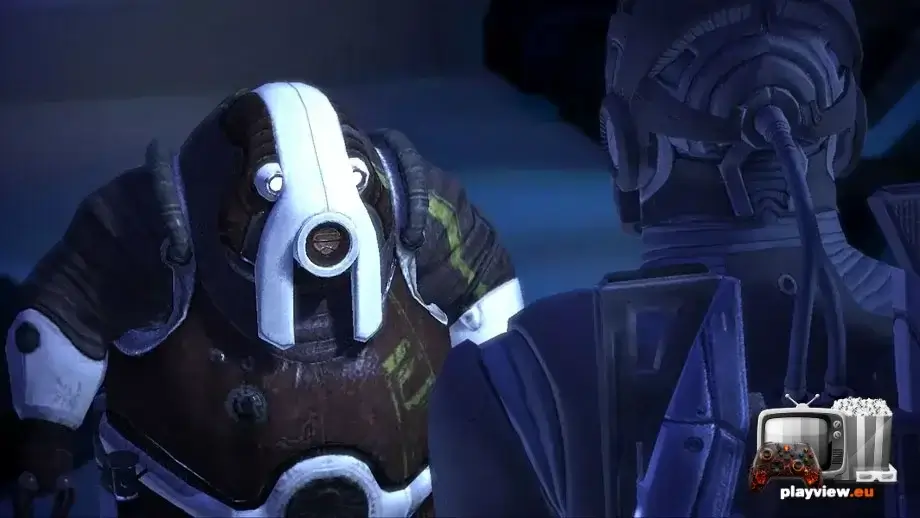
Ashley Williams, Kaidan Alenko, Garrus Vakarian, Urdnot Wrex, Tali'Zorah, and Liara T'Soni form part of a crew that is much more than a combat unit. They are characters with whom you can talk, disagree, build relationships, and gradually discover their pasts. Alongside them is Joker, the Normandy's distinctive pilot, who brings his own personality to the crew's everyday life.
And this is where Mass Effect truly begins to stand out.
Gameplay and the revolution of interactive storytelling
Mass Effect combined traditional RPG elements with third-person shooter mechanics. Players could choose between different classes, develop their abilities, equip their squad, and use weapons, technological powers, and biotic abilities.
Combat took place in real time, with a cover system and the ability to issue orders to the two squad members accompanying us. It was neither a straightforward shooter nor a classic RPG with turn-based combat. It was an attempt to combine two different gameplay philosophies.
Here, the PC version had its own advantage. Using a keyboard and mouse made aiming and combat management more direct. Biotic and technological abilities could be assigned to number keys, while weapon access was handled through the function keys. This meant we did not have to constantly interrupt the action to select every ability from a radial menu.
In addition, the PC version allowed us to issue separate commands to each of our two companions, rather than treating the squad as a single unit. The new Tactical HUD, which appeared when pressing the Space key, offered greater control over squad movements, attacks, and abilities.
The inventory was also redesigned, with better item categorization and easier equipment management through the mouse. Even the Mako, the vehicle used to explore planets, had improved controls, with separate keys for moving forward and backward.
BioWare had even changed the hacking and decryption minigame, replacing the original button-matching system with a different mechanic that required us to guide a cursor through concentric circles.
Not everything was perfect, but the overall effort showed that the company treated PC as a distinct platform rather than simply producing a straightforward port.
The real achievement, however, was somewhere else: in the conversations and decisions.
BioWare introduced the famous Dialogue Wheel, a circular choice mechanic that allowed players to select the general direction of their response without having to read entire paragraphs of dialogue. Shepard spoke with full voice acting, and conversations acquired a cinematic quality that was impressive for the time.
At the same time, the Paragon and Renegade system allowed us to shape a more diplomatic Shepard or a more aggressive and ruthless one. These were not simply good and evil responses. It was a way to create our own version of the protagonist.
Most importantly, our decisions could influence the fate of entire species, our relationships with squad members, and, above all, the future of the story.
What we now consider almost standard in many narrative-driven RPGs, Mass Effect made a fundamental part of its identity at a time when most games still treated storytelling as something relatively separate from gameplay.
Why Mass Effect is considered a pioneering game
Mass Effect was not the first game to feature choices, multiple paths, or dialogue that influenced the story. BioWare had already experimented with these elements in its previous productions. What it achieved, however, was bringing them together into a unified, cinematic, and remarkably coherent system.
First of all, it created a world that felt as though it existed independently of the player. The history of the Protheans, the politics of the Asari, Turians, and Salarians, the Krogan wars, the unusual relationship between the Quarians and the Geth, and the workings of the Council were not simply pieces of information added to fill a digital encyclopedia.
They were elements that influenced missions, dialogue, and our decisions.
The Codex, the game's in-game encyclopedia, was one of the finest examples of world-building. You could spend hours reading about the history, technology, politics, and biology of the different species. What was impressive was that all this information created a sense of historical depth rather than feeling like a collection of arbitrary details.
Equally important was the relationship with the crew. The characters did not exist simply to help you in combat. They could disagree with you, reveal personal experiences, and make you question even decisions you initially considered obvious.
Mass Effect therefore established an important standard for modern story-driven RPGs: the story does not have to be something you watch between missions. It can be the very system through which you play.
And there is one more element we should not underestimate: the creation of a trilogy featuring a shared protagonist and continuity between player decisions. The idea that a character and their choices could carry over into subsequent games, shaping one unified adventure spanning dozens of hours, was an extremely ambitious approach.
It was not simply the promise of a sequel. It was the promise of a story that would remember what you had done.
Graphics and the technical side
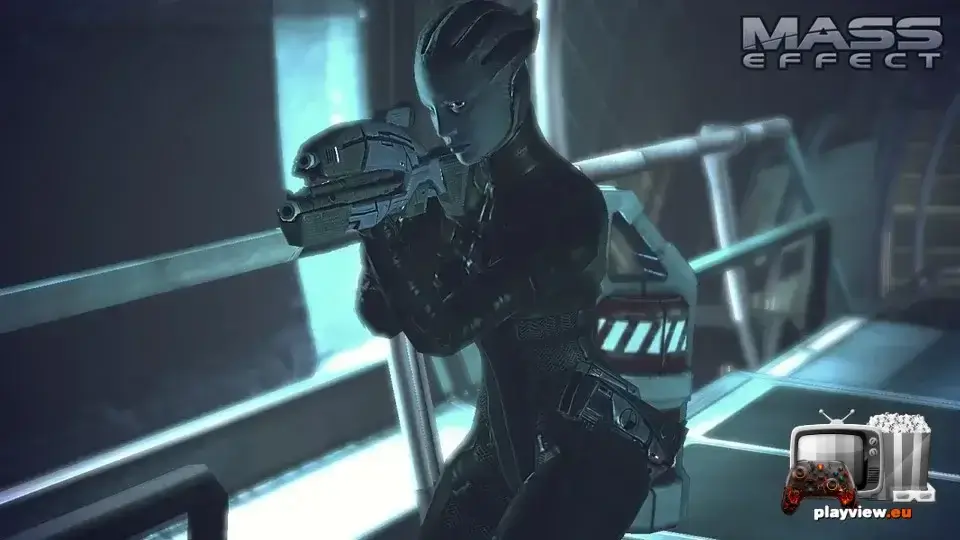
For 2007 and 2008, Mass Effect was a particularly impressive game. BioWare used Unreal Engine 3 and attempted to take advantage of the capabilities of the then-new generation of systems, placing particular emphasis on faces, expressions, and cinematic sequences.
The PC version offered support for higher resolutions and a sharper image, providing a noticeably better presentation on suitable hardware and displays. It was not, of course, a complete graphical reconstruction. Character models and basic animations remained essentially the same as in the original version, while the improvements focused mainly on image clarity and presentation.
The characters featured impressive detail, while facial expressions and lip synchronization during dialogue created a fairly convincing sense of natural conversation.
The Citadel was perhaps the clearest example of the game's artistic philosophy. A gigantic space station, featuring different districts, alien species, political activity, and the feeling that you were standing inside a genuine center of galactic power.
The artistic result still has plenty of character. The music by Jack Wall and Sam Hulick, the visual design of the spacecraft, the suits, and the appearance of the alien species created an aesthetic that is immediately recognizable.
Not everything was ideal, however.
The game suffered from technical glitches, texture-loading problems, and occasional abrupt loading interruptions. In the PC version, elevator journeys were shorter, but small loading screens sometimes appeared when entering new areas or before battles.
Furthermore, several abandoned outposts and interior facilities reused similar layouts, which limited the sense of exploration.
Nevertheless, the overall presentation was excellent. Mass Effect managed to create a recognizable visual world and give players the feeling that they were participating in a major science-fiction cinematic production.
The problems with the first game
It would be unfair to present the first Mass Effect as a flawless masterpiece. Especially today, with the experience we have gained from the subsequent games, some of its weaknesses are even more apparent.
The combat system, despite the improvements in the PC version, was not always ideal. Aiming and movement lacked the precision of a dedicated shooter, while squad AI could become frustrating. Some battles were more exhausting than enjoyable, especially when the squad failed to follow your commands correctly.
The inventory, although significantly improved on PC, still contained a huge amount of equipment. Managing weapons, armor, and upgrades could become tedious, particularly when you had to examine dozens of items.
The Mako was an interesting idea, but exploring planets was not always enjoyable. Uneven surfaces and steep slopes could turn a simple journey into a small adventure of their own.
In addition, the planets we could explore outside the main missions often featured repetitive facilities and similar environments. The sense of freedom was impressive as an idea, but the actual variety did not always live up to expectations.
Finally, the Paragon/Renegade system had certain limitations. Although it offered interesting choices, the development of Shepard's personality did not always translate into meaningful changes to abilities or the overall experience.
These shortcomings, however, did not undermine what the game achieved. On the contrary, they make it even more impressive that BioWare managed to create such a strong foundation for everything that followed.
Personal Relationships and the Romance System
Another element that made Mass Effect stand out was the ability to develop romantic relationships with members of the crew. BioWare did not want Shepard's companions to be merely characters who followed them into battle. It wanted to create personal bonds through conversations, trust, emotional moments, and decisions that could change the way we related to them.
In the first game, there were three main romance options: Liara T'Soni, Ashley Williams, and Kaidan Alenko. Liara was available to both male and female Shepard, while Ashley was an option for male Shepard and Kaidan for female Shepard.
The development of these relationships was not based on a separate point system or simple dating-simulator-style dialogue choices. You had to visit the characters aboard the Normandy, talk to them, learn more about their pasts, and choose responses that created greater familiarity. Relationships could gradually develop until they reached a more personal and romantic connection.
Liara's case was particularly interesting, as her relationship with Shepard was one of the most fully developed romantic storylines in the first game. Her different background, scientific curiosity, and distinctive personality gave the relationship another dimension.
What made the system truly significant, however, was continuity. Romantic choices did not disappear when the first game was completed. Through save-file transfers, they could influence relationships and conversations in Mass Effect 2 and Mass Effect 3. This meant that a relationship that began in 2007 could continue developing throughout the entire trilogy.
For its time, this was a particularly advanced approach. BioWare demonstrated that emotional bonds could be an organic part of an RPG rather than simply an optional activity. This further strengthened the feeling that the Normandy's crew was not just a collection of digital characters, but a group of humans and aliens with whom you developed genuine relationships within the game world.
Critical and public reception
Mass Effect received an outstanding reception. The original Xbox 360 version achieved a score of 91/100 on Metacritic, based on 74 professional reviews. The PC version also received an excellent response, with a Metascore of 89/100.
GameSpot awarded the PC version 9/10, describing it as the best way to experience the game. Chris Watters' review, published in May 2008, acknowledged that the changes did not amount to a radical reconstruction, but had a significant positive impact on the experience.
Particular praise was given to the shortcuts for biotic and technological powers, the new tactical command system, the easier inventory management, and the improved Mako controls.
GameSpot, however, did not hide the fact that certain graphical problems and occasional loading screens remained.
In its own review of the PC version, Ars Technica focused particularly on the improvements to the user interface. It pointed out that the ability to use multiple abilities through keyboard shortcuts made combat much smoother, while the new inventory and mouse controls solved several of the original version's problems.
The overall assessment was that the PC version offered a more complete experience, without managing to fix every weakness in the original design.
Commercially, its success was also significant. According to figures presented by Microsoft in early 2008, Mass Effect had surpassed 1.6 million copies during its first weeks of release on Xbox 360. Microsoft presented it as the fastest-selling RPG on Xbox 360 and one of the most significant commercial achievements in the genre at the time.
These figures refer to the original release and should not be confused with the total sales of all subsequent editions.
This success confirmed to BioWare that its new universe had enormous potential and could develop into one of the industry's most important franchises.
The final confrontation — What happened at the end (Spoilers)
The real revelation of Mass Effect comes when Shepard begins to understand that Saren is not the actual threat.
Behind his actions is Sovereign, a gigantic and ancient synthetic spacecraft that is not simply an advanced weapon or another enemy. It is a Reaper.
Shepard discovers that the Reapers are an ancient race of synthetic intelligences that periodically return to the galaxy with the purpose of wiping out advanced organic civilizations. Their return is not a random military invasion, but part of a cycle that has been repeating for millions of years.
The Protheans, who until that point were believed to be an extinct civilization, were actually their previous victims.
Saren believes that cooperating with the Reapers is the only way for organic life to survive. He considers submission preferable to total destruction. Shepard, on the other hand, understands that there can be no real salvation through cooperation with them.
On the planet Ilos, Shepard encounters Vigil, an ancient Prothean artificial intelligence that reveals the secret behind the Citadel. The Protheans had managed to interfere with the Keepers, the creatures responsible for maintaining the enormous station, preventing the Reapers from using the Citadel as a gateway for their return.
Saren intends to restore this function and reopen the path for the Reapers.
The final battle takes place at the Citadel, where Sovereign launches its attack. Shepard confronts Saren, who has by now largely surrendered to the Reaper's will. Depending on our choices, we can even convince him to resist and commit suicide before Sovereign uses his mechanically modified body for the final confrontation.
In the final sequence, Shepard must make one of the game's most important decisions: save the Council by sending forces to protect the Destiny Ascension, or focus the fleet's efforts on destroying Sovereign.
If we choose to save the Council, the Destiny Ascension survives, but human casualties are greater. If we abandon the Council, the spacecraft is destroyed and the Council members lose their lives, while humanity's military power gains even greater influence.
In either case, Sovereign is destroyed and the immediate threat is eliminated.
Humanity gains a seat on the Council, and Shepard emerges as one of the galaxy's most important heroes. However, the story's final message is clear: Sovereign was merely one part of a much greater threat.
The Reapers are still out there.
And this is the moment when Mass Effect stops being merely a story about hunting down a traitor and becomes the beginning of an epic struggle for the survival of the entire galaxy.
A few details that make the universe even more interesting
BioWare began developing Mass Effect around 2005, with the goal of creating an entirely new intellectual property that could stand on its own, without depending on an existing franchise.
Drew Karpyshyn, one of BioWare's most important writers, played a decisive role in shaping the game's story and mythology. His work on Knights of the Old Republic provided an important foundation for the transition to an even larger narrative universe.
The game features an extensive voice cast. Among the familiar names are Seth Green as Joker, Marina Sirtis as Matriarch Benezia, and Lance Henriksen as Admiral Hackett. Shepard also had two different voice performances, with Mark Meer voicing the male version and Jennifer Hale the female version.
The Normandy did not receive its name by accident. The name references the historic Normandy landings during World War II, reinforcing the military identity of the spacecraft and its crew.
One of the most interesting design elements is the use of scientific terminology to establish the game's technology. Element Zero, dark energy, and the Mass Relays are not simply random science-fiction names. BioWare attempted to create an internally consistent technological model so that the world would feel as believable as possible.
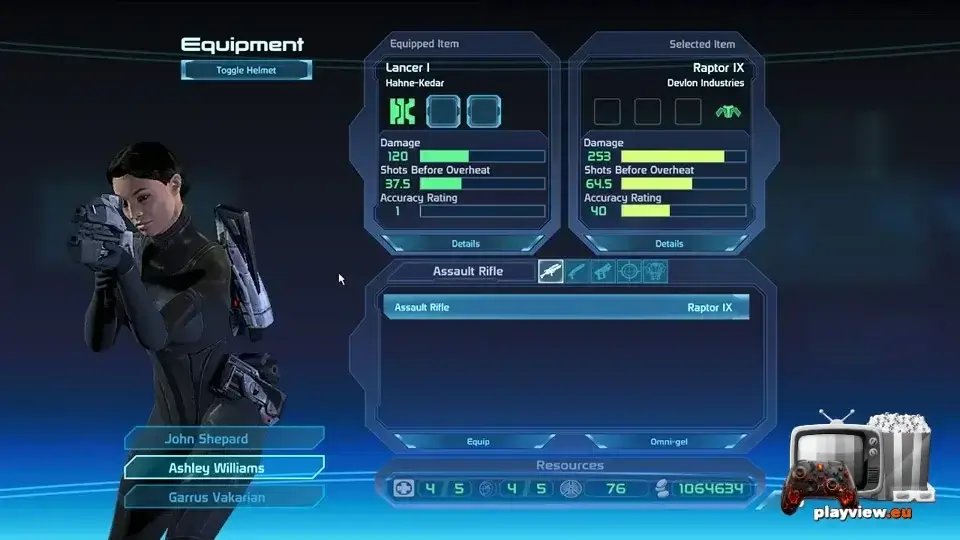
It is also worth remembering that the PC version was not released with different controls alone. Its port was developed by Demiurge Studios in collaboration with BioWare, while the delay in its release was used to further improve the user interface and additional features.
The PC version also included the Bring Down the Sky expansion at no additional cost, giving players an extra mission and another story within the game's universe.
And, of course, Mass Effect found a new life in 2021 with the release of Mass Effect Legendary Edition, which brought together the original trilogy, improved its visual presentation, and modernized several mechanics, particularly in the first game. For anyone who wants to return to the beginning of the story today, this is the most complete option.
For me, the first Mass Effect is one of those games that should be judged not only by what it achieved when it was released, but also by the legacy it left behind.
Yes, it had problems. The combat system needed work, the inventory could become tedious, the Mako was not always enjoyable, and its technical performance had its weaknesses. The PC version took significant steps in the right direction, but it could not fix every weakness in the original design.
However, the atmosphere, music, characters, mythology, and, above all, the feeling that you are at the beginning of an enormous adventure are elements that have lost none of their power.
Personally, I believe BioWare achieved something very difficult: it created characters you do not simply remember because you encountered them in a game, but because you feel you spent an important part of your own gaming journey alongside them. Garrus (my personal favourite), Tali, Wrex (another personal favourite), Liara, and, of course, Shepard have become part of an entire generation of gamers.
And most importantly, the first game does not try to provide all the answers. It sets the scene, introduces its protagonists, and reveals a threat so enormous that it makes you want to continue immediately.
For me, Mass Effect is a series I have genuinely come to love. I have played all its games, experienced the different periods of its universe, and invested time in a story that extends far beyond the boundaries of an ordinary gaming adventure.
That is why, on Playview.eu, we will create a dedicated Hub for the Mass Effect universe, bringing together all the games in the series and their corresponding My View articles in one central location. There, readers will be able to discover the entire journey of the franchise, from Commander Shepard's first adventure to the later stories, alongside the characters, creators, and defining moments that shaped this galaxy.
We will not limit ourselves to simple overviews. We want to examine what each game achieved, what changed compared to its predecessor, how the storytelling evolved, and why Mass Effect continues to hold such a special place in gaming history. The goal is to create a comprehensive reference point for a franchise that deserves to be examined as one unified work rather than simply as a collection of separate releases.
Of course, I cannot hide my disappointment over what happened to BioWare. On October 21, 2026, the studio's official closure was announced, following more than 30 years of creative work. At the same time, development of a new Mass Effect, which was still in its early stages, was also halted.
It is a truly sad development. Electronic Arts may see figures, costs, and business decisions, but for players, BioWare was much more than a line in a financial report. It was a studio that created worlds we wanted to return to.
I would genuinely like to see the BioWare name return, whether through an acquisition by another studio or investment group, or through a new effort supported by the Canadian side. There is currently no confirmed plan for anything like this, but I believe such an important creative legacy deserves to be preserved.
And I would like even more to see Mass Effect continue, not as a simple commercial exploitation of a historic name, but as a creation that respects its legacy.
Mass Effect was not simply the beginning of a series. It was the beginning of a galaxy in which millions of players found their own place. And that is something no business decision can erase.


