
Played on PC Windows
A new galaxy, a different beggining (?)

After the original Mass Effect trilogy came to an end, BioWare faced a difficult creative dilemma. Commander Shepard’s story had reached its conclusion, closing a huge chapter regardless of how each player felt about the different versions of the finale. Creating a Mass Effect 4 with the same protagonist would have meant either continuing a story that had already been completed or choosing one of the different Mass Effect 3 endings as the official outcome. BioWare decided not to go down that road. Rather than trying to bring Shepard back, it chose to keep the Mass Effect universe alive by moving the action to a different part of the galaxy and introducing new characters, new threats and an entirely different mission.
The decision made sense. The universe BioWare had created was much bigger than the story of one military commander and his crew. There were countless species, civilizations, planets and stories waiting to be explored. Mac Walters, who had played an important role in the franchise’s creative direction and had worked as a writer on the previous games, was involved in the transition to this new era. The idea was to return to something that had been at the heart of the original promise of Mass Effect: space exploration, the discovery of unknown worlds and contact with civilizations humanity knew almost nothing about. Andromeda would not be a straightforward continuation of Mass Effect 3, but a new beginning within the same universe.
BioWare Edmonton or BioWare Montreal? The Decision That Shaped Development
One of the most interesting, yet lesser-known, chapters in Andromeda’s history concerns the development team itself. Why didn't BioWare entrust the new Mass Effect to the experienced Edmonton team, the studio where the foundations of the original trilogy had been created? The answer is not that Edmonton had no involvement or that the company decided to exclude the people who had created the franchise. BioWare had opened its Montreal studio in 2009 and had gradually prepared it for greater responsibilities. The Montreal team had already contributed to the development of Mass Effect 2 and 3, working on a significant portion of the cinematics, missions, post-launch content and the third game’s multiplayer. In 2012, the company officially announced that the next Mass Effect would be led by Montreal, with support from Edmonton and Casey Hudson serving as Executive Producer. For BioWare, this was the next step in the evolution of a studio that wanted to prove it could take on a major game of its own.
There was, therefore, a business and organizational rationale behind the decision: BioWare wanted to build a second strong development team, distribute responsibilities between its studios and give Montreal the opportunity to establish its own identity. The problem was that this decision coincided with an extremely difficult period for the company. According to an extensive Kotaku report on the game's development, relations between the Edmonton and Montreal studios were not always smooth. There were disagreements over creative direction, coordination problems, staff being moved to other projects and employees leaving the company. Development was spread across different locations, making communication and decision-making even more difficult. In 2014, when Casey Hudson left BioWare, the team lost another important point of reference.
The most concerning detail is that, according to the accounts gathered in the same report, much of the final game only really took shape during the last 18 months or so before release. The team had spent a great deal of time on ambitious ideas and technical experiments, but many missions, dialogue sequences and other story elements were slow to reach their final form. Mac Walters was brought in to help reorganize the creative direction at a point when the project urgently needed a clearer path forward. This does not mean that the Montreal developers lacked talent or that the Edmonton team would have guaranteed a masterpiece. It does mean, however, that BioWare entrusted one of its most important franchises to a studio that was still proving it could handle such a major project on its own, without having secured the production stability it needed.
The result was not simply a game with a few technical problems. It was a title that showed clear signs of uneven development: excellent ideas that were never properly completed, systems that seemed to receive inconsistent attention and a story that, in several places, felt as though it needed more time. Perhaps the biggest irony is that Montreal never got the opportunity to build on this new beginning. After the game's release, the studio was closed and its staff were moved to other EA and BioWare teams.
A Journey 600 Years Away from Shepard
Mass Effect: Andromeda was released in March 2017, with its European launch taking place on March 23. Its story takes place approximately 600 years after the Andromeda Initiative departed from our galaxy. The mission had begun before the Reaper invasion, with the goal of transporting humans and other species to a new galaxy in search of habitable planets and a second chance for humanity. This allowed BioWare to avoid choosing one particular Mass Effect 3 ending as the official continuation. The Andromeda Initiative had left before the events of the original trilogy, while the passengers aboard the arks awaken in an era when their former home has changed dramatically.
We take on the role of Scott or Sara Ryder, the children of Alec Ryder, the original Human Pathfinder. The Pathfinder is responsible for discovering new worlds, assessing whether they can support settlers and leading the mission towards survival. Very quickly, however, the mission proves far more difficult than anyone expected. The planets are not as welcoming as hoped, the Remnant infrastructure hides secrets nobody understands, and an aggressive alien force known as the Kett threatens the Initiative's efforts. At the center of the conflict is the Archon, a leader particularly interested in Remnant technology and the mystery behind it.
SAM, the artificial intelligence linked to the Pathfinder, also plays an important role, allowing them to understand and make use of Remnant technology. Ryder's relationship with SAM is a central part of the story and distinguishes the new protagonist from Shepard. This time, we do not have an experienced soldier tasked with saving the galaxy. Instead, we have someone suddenly thrust into a position of enormous responsibility, trying to prove they can become the leader of a mission that is on the verge of collapse.
Personally, I believe one of the biggest mistakes in BioWare's history was its sale to Electronic Arts. The deal was announced in October 2007 and finalized in January 2008. From then on, BioWare gradually shifted into a very different corporate environment, where creative decisions could no longer be decoupled from the priorities of a massive publisher. EA is a financial powerhouse that spent years expanding its portfolio through studio acquisitions. Unfortunately, its track record is also littered with creative teams that were bought up, absorbed, and ultimately shut down or stripped of their original identity. As far as I'm concerned, EA has earned a reputation as a genuine killer of creative studios. And BioWare is perhaps the most painful example of all, especially considering everything it had contributed to the gaming industry before falling into their hands.
Andromeda was not the work of a single individual. Its writing team included Mac Walters, Cathleen Rootsaert, John Dombrow, Lukas Kristjanson, Sheryl Chee and Jay Watamaniuk, creators who had already worked on previous games in the franchise. They were joined by other writers, including Chris Schlerf, Joanna Berry, Hall Hood and others. Having people with experience from the original trilogy was important, as BioWare wanted to preserve the philosophy of Mass Effect: characters with personality, relationships that evolve through player choices and a story combining politics, science fiction and personal dilemmas.
However, having experienced writers does not automatically guarantee a good script. The final result showed that the creative team struggled to find the same balance achieved by the original trilogy. There are interesting ideas, certain characters who gain depth as the adventure progresses and moments that remind us of the old BioWare. There are also dialogues that feel rushed, characters who are not developed as much as they should be and missions that fail to deliver the tension we expect from a Mass Effect game.
Graphics: A Beautiful Galaxy with Awkward Expressions
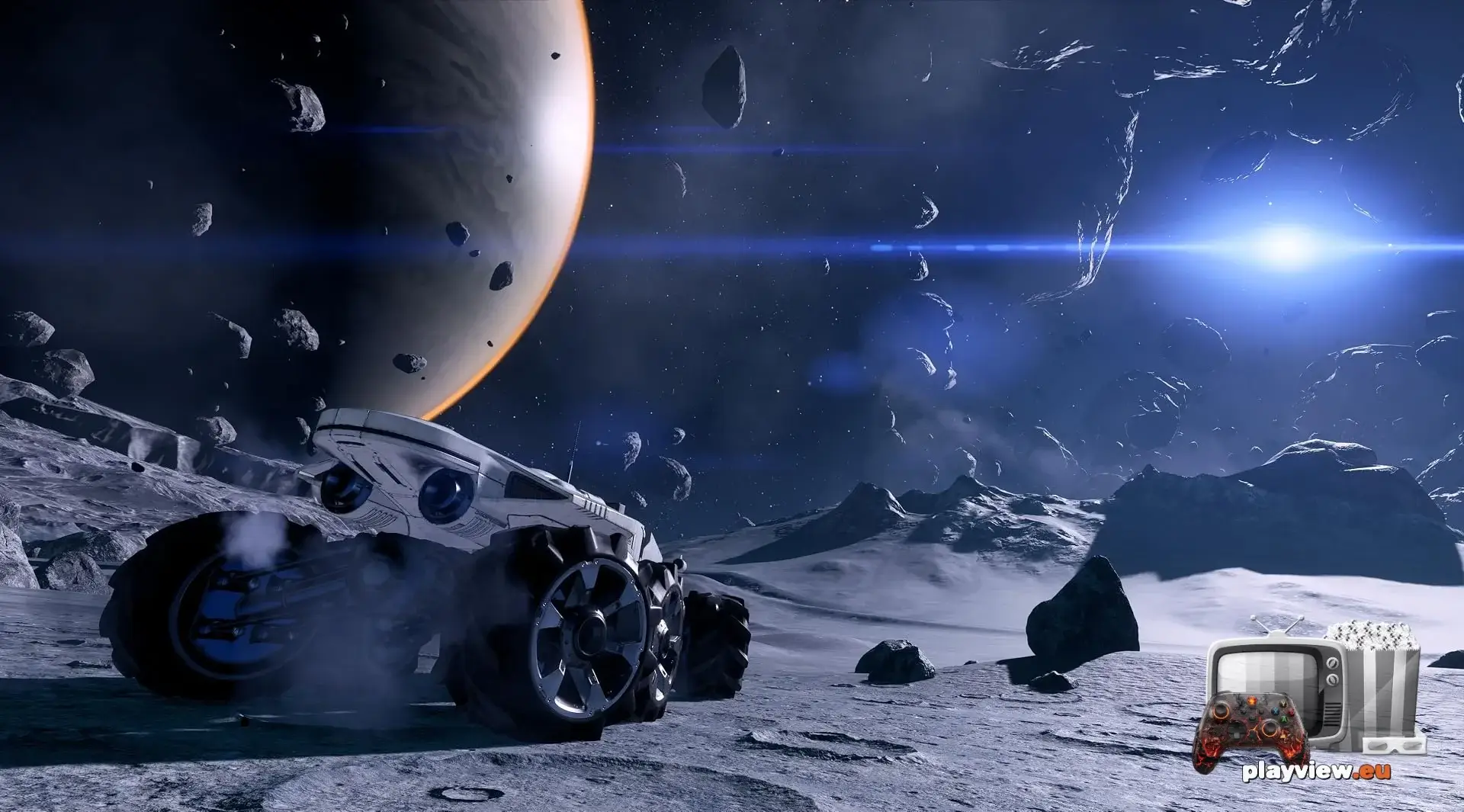
Andromeda uses the Frostbite 3 engine, leaving behind the technology used by the original trilogy. This transition allowed BioWare to create large, impressive planets with distinct environments, atmospheres, lighting and geography. Snow-covered landscapes, deserts, alien installations and areas shaped by Remnant technology can produce some truly beautiful visuals. Exploration is one of the game's strengths, and there are moments when you genuinely feel that you are standing in an unknown galaxy waiting to be discovered.
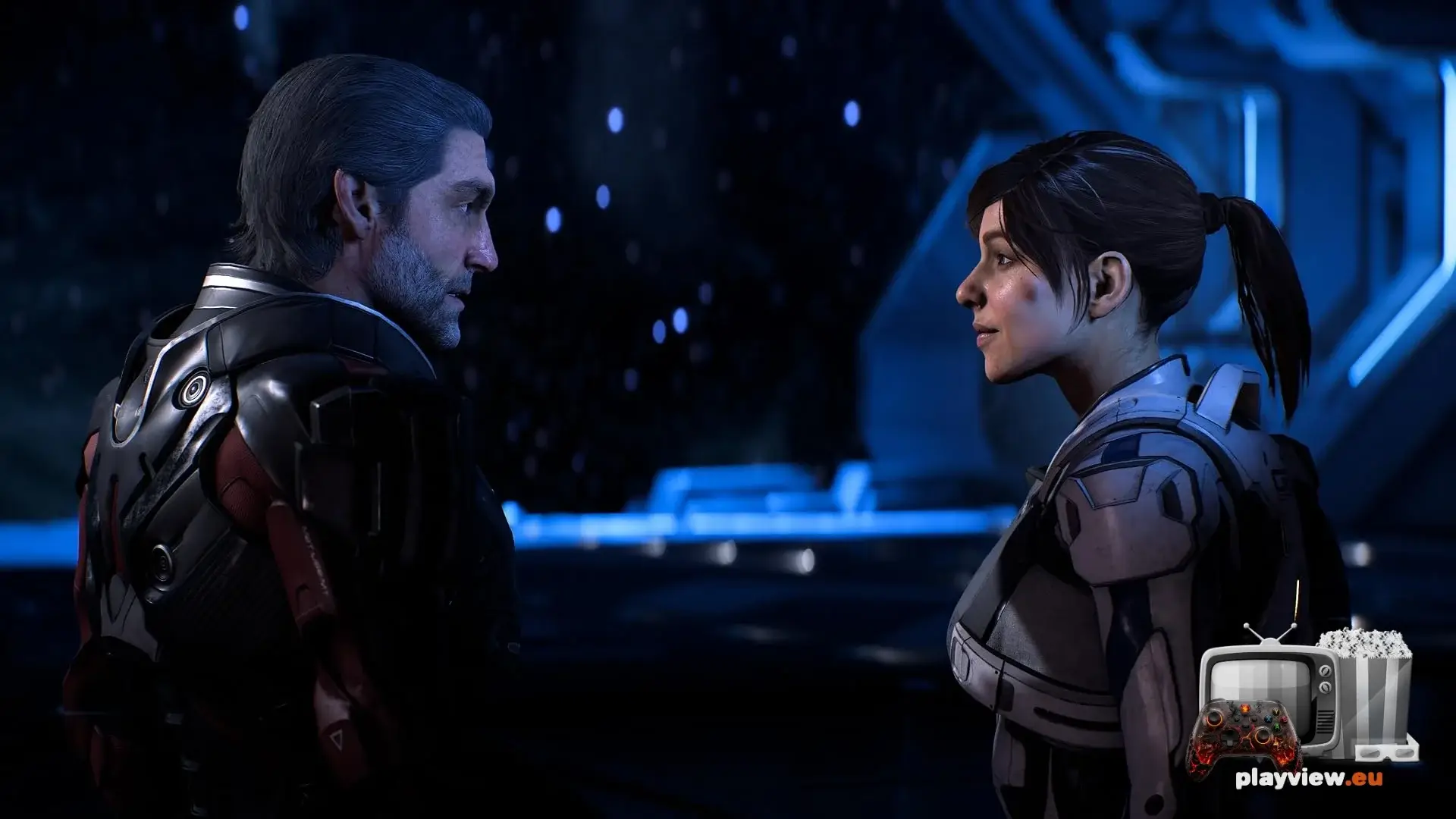
Unfortunately, the technical presentation was not equally successful everywhere. Character models, and facial expressions in particular, became some of the biggest problems at launch. Conversation animations often looked stiff, eye and mouth movements did not always match the characters' emotions, and certain scenes became unintentionally funny. The problem was even more noticeable because Mass Effect relies heavily on conversations and the emotional reactions of its characters. When a serious moment is not visually convincing, much of its impact is lost. BioWare released updates to improve animations and fix other technical issues, but the first impression had already been made and was difficult to reverse.
Gameplay: More Freedom, Better Combat, Less Identity?
In terms of gameplay, Andromeda takes several steps towards a faster and more dynamic experience. The combat system is considerably more flexible, with greater mobility, jetpack abilities and more immediate switching between weapons and biotic or technological powers. Players are no longer locked into a fixed class as they were in previous games. They can develop different skills, create Profiles and change their combat style depending on the situation. This offers greater freedom and makes encounters faster, more spectacular and more enjoyable.
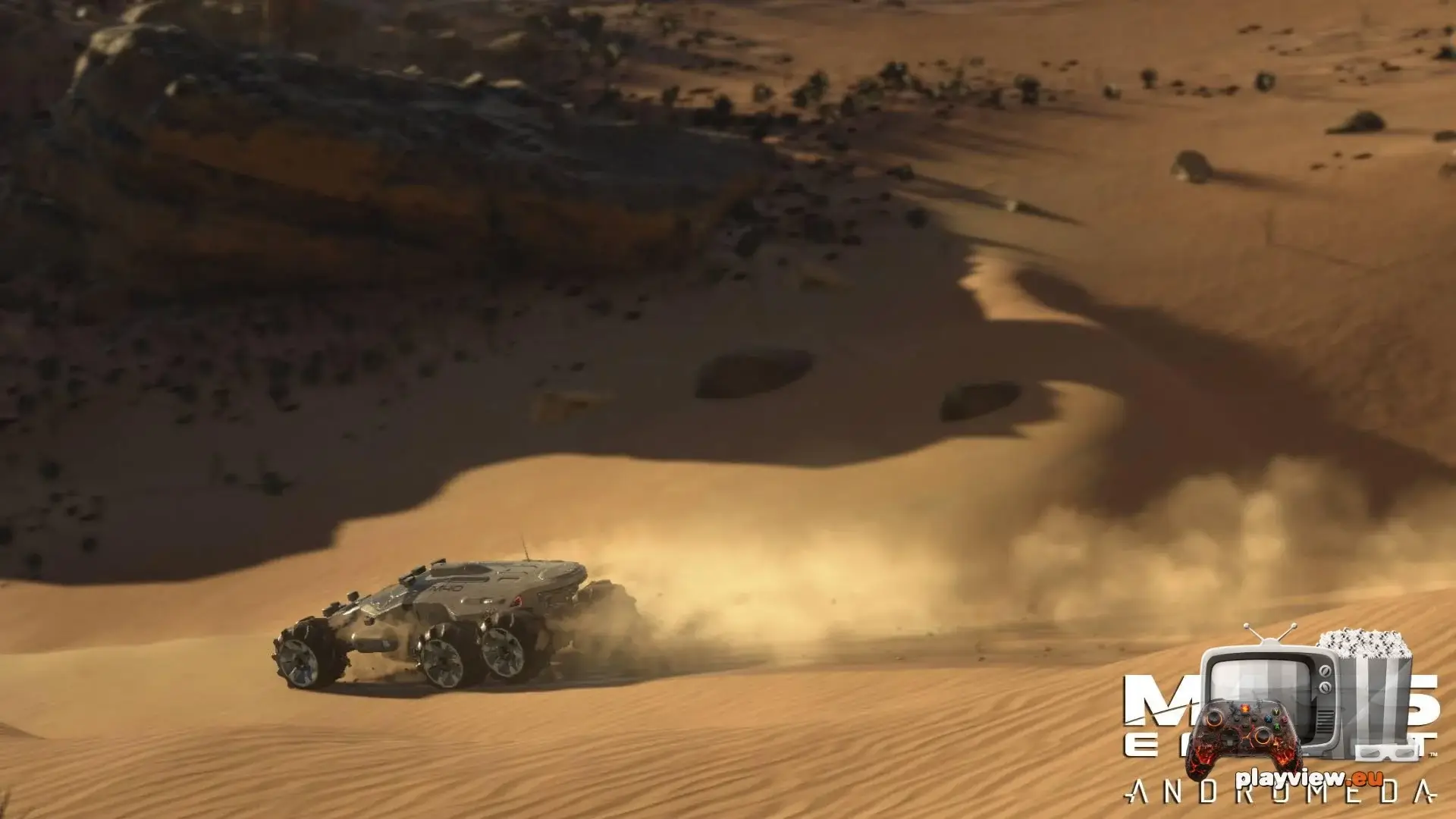
The Nomad replaces the Mako as the main vehicle for planetary exploration. Driving it is more enjoyable, and discovering new areas is tied to the effort to increase each planet's viability. We activate installations, explore Vaults, deal with environmental hazards and attempt to create conditions suitable for colonization. It is an excellent idea, connecting exploration directly to the central goal of the Andromeda Initiative.
The problem is repetition. Many side missions eventually turn into a series of simple instructions: travel to a location, scan something, find an object, speak to a character and then move to another area to complete the next step. There is plenty of content, but its quality is inconsistent. Some missions are worth your time, while many others feel more like chores than meaningful adventures. This is where the game loses some of the density and pacing of the original trilogy.
Companions, Relationships and Romances
As in every Mass Effect game, companions are among the most important elements of the experience. In Andromeda, we meet characters such as Cora Harper, Peebee, Vetra Nyx, Liam Kosta, Jaal Ama Darav and Drack. Each has a different personality, background and reason for joining the mission. Cora has military training and a strong connection to the Asari, Peebee is an independent and unpredictable Asari, Vetra is a Turian who has learned to survive in difficult circumstances, while Drack brings the experience and distinctive personality of an elderly Krogan. Jaal, meanwhile, is one of the most interesting new characters, introducing us to the Angara and their culture.
Relationships with the crew are once again important, and romances return with several options. Depending on Ryder's gender, different relationship possibilities become available. Peebee, Vetra and Reyes are available to both protagonists, while Cora and Gil are options for Scott. Sara can develop relationships with Liam, Suvi and Jaal, while there are also smaller romantic storylines involving characters such as Avela and Keri. BioWare retains one of the features that made the franchise special: relationships are not simply a menu option, but develop through conversations, missions and personal moments.
Nevertheless, not every character has the same depth. Some gradually win the player over, while others fail to achieve the same emotional significance as Garrus, Tali, Liara, Wrex or Mordin. Comparing them with the original crew is inevitable, but it is not entirely fair: those characters had three games to develop, whereas the new characters had to win over the audience in a single release. Even so, Andromeda does not always manage to create the same sense of family between the protagonist and the crew.
The “Woke” Debate: What Is Actually There?
BioWare has found itself at the center of discussions about the representation of different identities, LGBTQ+ relationships and social themes in its games on several occasions. In recent years, some members of the audience have described these choices as “woke practices”, arguing that the company gives excessive priority to social and political messages at the expense of storytelling. It is important, however, to distinguish the actual presence of these elements from the political interpretations attached to them. The existence of LGBTQ+ characters, different cultural identities or gender choices does not, by itself, prove that a game has sacrificed its quality to promote an agenda.
Andromeda certainly includes more representation. Relationship options are more open than in some earlier games, there are characters with different identities, and BioWare attempted to present a more diverse population within a mission that supposedly brings together different species and cultures. The most notable example is Hainly Abrams, a transgender character whom we encounter on one of the first planets. Her initial introduction caused considerable controversy because the game revealed personal information about her gender identity very early and in an awkward manner, without first establishing the character or building a relationship with the player.
BioWare itself acknowledged that Hainly's introduction had not been handled with the necessary care and sensitivity. The company issued a public apology and changed her dialogue after discussions with transgender people both inside the company and within the wider community. This is a real, documented incident, not simply a theory created by the community. On the other hand, it would be wrong to attribute all of Andromeda's problems to the attempt to increase representation. Weak dialogue, repetitive missions, animation issues and an unstable development process are problems related to the game's overall production and creative execution.
My own view is that BioWare had every right to include different characters and relationships in the Mass Effect universe. The problem is not representation itself, but how a character is written and integrated into the story. When a social theme is presented naturally and organically, it can add depth to the world. When it is introduced awkwardly, without proper development or through dialogue that feels more like an informational statement than a natural conversation, it creates distance between the player and the character. In Andromeda, there were moments when the intention was clearly positive, but the execution was not always successful. That is a much more meaningful point of criticism than simply applying the label “woke” to the entire game.
What the Critics Said: The Flaws That Could Not Be Ignored
Mass Effect: Andromeda was not completely destroyed by reviews, but it certainly failed to reach the level of acclaim enjoyed by the previous games. Its scores were noticeably lower than those of the original trilogy, with Metacritic recording approximately 76/100 on PC, 72/100 on Xbox One and 71/100 on PlayStation 4. Some reviewers recognized the quality of the combat system, the large planets and the exploration, but the general impression was that the game had plenty of good ideas without consistently making the most of them.
GameSpot gave it 6/10, pointing out that weak facial expressions, stiff dialogue, repetitive missions and technical problems undermined the experience. The review particularly criticized the fact that many open-world missions amounted to simple travelling and repetitive actions, making the player feel more like a space delivery driver than a Pathfinder discovering an unknown galaxy. The main problem was not the amount of content, but the fact that much of it lacked variety or meaningful interest.
Even more disappointing was the narrative side of things. Mass Effect had built its reputation on political conflict, tough choices, inter-species dynamics, and memorable characters. Andromeda tries to forge a new lore, but all too often its story feels simplistic, featuring a main antagonist who never quite carries the weight you'd expect and quests that don't always pack the necessary dramatic punch.
The Guardian also pointed out that the dialogue often becomes awkward or excessively casual, even in moments that should carry a more serious tone, while animation problems and bugs further damage the atmosphere.
The technical shortcomings were particularly noticeable at launch. There were issues with audio synchronization, characters appearing incorrectly during conversations, glitches and inconsistent performance depending on the platform. BioWare released several patches, improved animations and introduced other fixes and customization options, but the damage to the game's first impression had already been done. And this is perhaps the most critical point: a game that wanted to launch a new era for Mass Effect could not arrive on the market with such obvious problems and expect players to show it the same patience they had shown previous releases.
Sales and Commercial Performance
Despite its mixed reviews, Andromeda was not a commercial failure in the simplest sense of the term. Its launch had a significant presence in the market, and EA stated that its performance had been below the company's expectations. However, there is no officially confirmed lifetime sales figure that would allow us to say with certainty how many copies it sold over its entire lifespan. That is why we should be careful with figures that occasionally appear online and are presented as definitive numbers.
The most significant commercial and strategic consequence was that BioWare and EA did not proceed with the single-player story DLC that would have continued the game's story. In August 2017, the studio announced that patch 1.10 would be the game's final update and that there were no plans for further single-player content or story DLC. The team stated that the stories of Andromeda would continue through comics and novels, including the story of the Quarian Ark. This decision left several questions unanswered and effectively brought the game's journey as a new series to a halt.
What Happened at the End? Spoilers
Towards the end of the story, Ryder and the crew manage to confront the Archon and reach Meridian, a massive Remnant world-machine capable of affecting the viability of the entire region. The final conflict revolves around control of Meridian and the power it can offer to whoever manages to activate it. The Archon wants access to this technology so that he can impose his dominance, while Ryder attempts to stop him and secure a future for the Initiative and the Angara.
With the help of SAM and their allies, Ryder manages to foil the Archon's plans. The battle concludes with the activation of Meridian and a transformation of conditions in Andromeda, opening the way for new colonies and the survival of the different species. Ryder is now recognized as the Pathfinder who managed to lead the Initiative towards a new beginning. However, the story does not tie up every loose end. Questions remain about the Benefactor, Jien Garson's death, the fate of the Quarian Ark and the true extent of Remnant technology.
Another personal and important element of the story concerns Ryder's mother, Ellen, who remains in cryogenic stasis. Her condition and the possibility of finding a way to save her form one of the emotional threads of the family storyline. Meanwhile, the absence of the Quarian Ark leaves a major gap in the mission, as the Quarians and the other species travelling with them have yet to reach their destination. BioWare had clearly left room for a continuation, but that continuation never arrived in the form of a proper story DLC or a direct sequel.
Facts Worth Knowing
Andromeda was the first main game in the franchise that did not feature Commander Shepard as its central protagonist and did not take place in our galaxy. The time gap of approximately 600 years allowed BioWare to create a story that was not directly dependent on the ending of Mass Effect 3. The Andromeda Initiative had begun its journey before the Reaper invasion, meaning that the characters had no knowledge of what had happened back in their former home.
The game's soundtrack was composed by John Paesano and follows a different direction from the music of the original trilogy. Rather than relying exclusively on the familiar epic and military atmosphere, it places greater emphasis on discovery, isolation and the unknown. The music attempts to underline the fact that, this time, we are not in a galaxy we already know, but in a new place where every discovery could change the course of the mission.
The multiplayer returned with cooperative missions, while BioWare had also designed story-based APEX missions that would expand the game's narrative. However, the biggest unfulfilled promise was the continuation of the Quarian Ark storyline. BioWare confirmed that there would be no single-player story DLC, while that particular story was moved to other formats, including novels and comics.
My Final View
Mass Effect: Andromeda is a game that will always leave me with mixed feelings. On one hand, I completely understand why BioWare wanted to leave Shepard's story behind and start something different. The idea of the Andromeda Initiative, exploring an unknown galaxy, discovering new civilizations and trying to create a new home for humanity was an excellent foundation for a new chapter. The combat system is enjoyable, the planets are beautifully designed, and there are characters and missions that show what this new series could have become with more time and better direction.
On the other hand, I cannot ignore its shortcomings. The story does not have the same strength, the dialogue is not always successful, the side missions become tiring and the technical presentation at launch was below what I expected from such an important franchise. The biggest problem, however, is not only what failed. It is everything that could have worked if BioWare had given the project clearer direction, more time and a more stable development team.
I do not consider Andromeda a bad game. I consider it a game with ambitions far greater than what it ultimately managed to deliver. And perhaps that is what disappoints me the most. Andromeda had all the ingredients to become the beginning of a major new trilogy, but it ultimately remained a standalone chapter with many unanswered questions. We will never know how Ryder's story would have developed, what really happened to the Benefactor, where the Quarian Ark is or what other threats were waiting for the Initiative.
The End of an Era and the Future of Mass Effect
Personally, I believe one of the biggest mistakes in BioWare's history was its sale to Electronic Arts. The deal was announced in October 2007 and finalized in January 2008. From then on, BioWare gradually shifted into a very different corporate environment, where creative decisions could no longer be decoupled from the priorities of a massive publisher. EA is a financial powerhouse that spent years expanding its portfolio through studio acquisitions. Unfortunately, its track record is also littered with creative teams that were bought up, absorbed, and ultimately shut down or stripped of their original identity. As far as I'm concerned, EA has earned a reputation as a genuine killer of creative studios. And BioWare is perhaps the most painful example of all, especially considering everything it had contributed to the gaming industry before falling into their hands.
I am not saying that all of BioWare's problems began exclusively with the acquisition. Poor creative decisions, troubled productions and commercial failures also involve internal responsibility. However, I believe the company should never have lost its meaningful creative independence. I wish it had remained an independent creative studio, with the freedom to decide which games it wanted to make and how it wanted to make them, without having to depend on the changing business priorities of a publisher. Companies such as CD Projekt have shown that it is possible to build a major presence in the industry while maintaining your own creative identity. Even Naughty Dog, although it belongs to Sony, is an example of a studio that has preserved a strong creative identity within a larger organization. That is exactly what I would have wanted BioWare to achieve: to protect its own philosophy, its people and its freedom to create the games it genuinely believes in.
And so, we reach the real end of this story. On October 21, 2026, BioWare officially announced its closure, while EA confirmed that development of the next Mass Effect had been halted, a project that was still at an early stage. A studio that gave us Baldur's Gate, Knights of the Old Republic, Dragon Age and, of course, Mass Effect — masterpieces that I will soon be adding to Playview.eu — is bringing its journey to an end after more than thirty years. I cannot help feeling disappointed, but also deeply saddened, as I watch such an important part of video game history reach this point.
I will, however, bring this Mass Effect feature to a close with one final presentation: the upcoming television series being developed by Amazon MGM Studios. Despite the recent developments and BioWare's closure, the latest reports indicate that the series remains in active development, with its creative team still attached to the project. Its story is not expected to be a retelling of Commander Shepard's adventure, but a new narrative set within the Mass Effect universe, taking place after the original trilogy. There, we will take a closer look at everything we know so far, as well as what has come to light about the next game in the franchise, which was unfortunately cancelled before it ever had the chance to reach our hands.
The first Playview.eu Hub was dedicated to the legendary series I love, Sons of Anarchy. I chose the second one to focus on one of my all-time favourite video game franchises, Mass Effect. And what comes next? In the near future, I will return with another legendary story, this time from the world of cinema: The Godfather.
Until then, I look forward to reading your comments on each game individually, as well as on the Hub itself. Which Mass Effect did you love the most? Which character stayed with you? And, above all, do you believe the franchise deserved a different future? The conversation is always open on Playview.eu!
I genuinely wish it had been given a second chance. Not because it was already a masterpiece, but because it had a world that deserved to be explored further. BioWare opened a new door, but never allowed us to see what was waiting on the other side. And for a universe like Mass Effect, that is perhaps the greatest shame of all.


