MY VIEW · UPDATE
S02E04 - And the chess game continues
Mobland · 11/10/2026
Overall, then, a very good episode, with clever moves, mounting tension, and a finale that shifts the conflict from the criminal chessboard to Harry's personal life. The series continues to patiently build toward the showdown, leaving several questions open for the future.
In a rather good episode, we once again had pawns moving on the chessboard, with Harry at the center of the episode. The bomb-helmet at the end of the third episode was essentially yet another wake-up call, an alarm to rouse everyone. The problem, of course, is that in this world it is not enough to wake up in time. You also have to figure out who is already two moves ahead of you.
Harry starts by updating Conrad on what happened at the meeting with Frankie Cooper and Kat McAllister's side. The family patriarch wants to know if Harry actually turned down Kat's offer, while the conversation once again reveals Conrad's difficulty in trusting people, even when they have repeatedly proven their worth. Knowing very well who he is dealing with, Harry gets up to leave. He is not going to sit around apologizing for every decision he makes, especially when the family itself depends on his ability to see what the others ignore.
And here lies one of the most interesting elements of the episode. Conrad knows that Harry remains loyal. He even explains it to his daughter, emphasizing that Harry's loyalty is not something that changes easily. The question, however, is whether Conrad truly understands what this loyalty means or if he thinks it gives him the right to push him without limits. Harry is not someone who constantly needs validation from the family. He is the man called upon to fix its mistakes, even when its own members create new problems.
At the same time, Eddie and Gina leave for Ireland, following the direction Maeve has given. The real reason behind this move remains one of the questions I want to see answered. Maeve rarely does anything without having calculated what she stands to gain from it. The fact that she is sending people away from London, at a time when the balances within the family are becoming increasingly fragile, hardly seems like a simple family arrangement. Especially when we know that her plans do not necessarily align with those of Conrad.
Harry, the police, and a very clever test
The police side of the story offers one of the most characteristic moments of the episode. Harry learns that the superior of his man in the police, Finch, is starting to suspect that something is wrong. The cover-up of the explosion and the previous cases have left plenty of traces, while DCI Kavanagh begins to examine the contradictions in the case more closely.
Harry, instead of waiting to see if the situation will betray him, decides to test the system. He organizes a jewelry store heist, leaving behind evidence that should mobilize his police source. As I was watching the scene, I wondered why he would risk such a thing. However, as soon as I saw him walk away and leave the car, the logic behind the move became clear. He wasn't simply interested in the robbery. He wanted to find out if the information would reach him.
This is the kind of composure that makes Harry so effective. He doesn't rely solely on violence, connections, or his ability to intimidate. He observes reactions, creates conditions that reveal the truth, and then decides his next move. He is a man who treats even the possibility of betrayal as a problem to be solved.
The answer, unfortunately, is final. Finch ends up dead, with his death staged as a suicide so that he no longer poses a threat to Harry and the Harrigan family. This development shows how easily people used as tools in this world become expendable. As long as they are useful, they remain part of the game. When they become dangerous, their place on the chessboard disappears.
And this is something Harry knows all too well. The question is how much longer he will manage to control the consequences of his decisions himself, when every solution creates a new danger.
Amidst all this, Seraphina continues to be one of the most interesting factors in the story. Harry suggests that she play the role of a double agent, a move that could prove particularly useful, but at the same time places her in an extremely dangerous position.
Seraphina finds herself caught between conflicting interests and people who are not known for their leniency. Her collaboration with Kat McAllister has already complicated matters, while her relationship with the Harrigan family is not as simple as one might like to believe. Harry seems to understand that he cannot control every move others make. He can, however, try to steer the information in his own direction.
Personally, I want to see how this story unfolds. Double espionage is a game that works as long as those involved believe they can keep their secrets. The moment someone is exposed, however, alliances can collapse within a matter of seconds. And in this particular series, trust is arguably more dangerous than a weapon.
The finale takes us back to Conrad, who decides to respond to Frankie Cooper's moves in the way he knows best. Patience is not exactly his strong suit, especially when he feels that someone is challenging his authority.
Conrad attacks Frankie's men, kills several of them, and takes a hostage. It is a show of force that leaves little room for misinterpretation: the Harrigan family is not going to passively accept the attacks of its rivals. On the other hand, such moves may offer momentary satisfaction, but they do not guarantee that they will bring Conrad any closer to the control he desires.
Frankie, however, has his own answer. He sends Harry a video of his wife, Jan, in intimate moments with Jamie. And somewhere around here, the conflict stops being exclusively about crime families, business, and power balances. Frankie hits Harry on a much more personal level.
It was obvious that this was yet another attempt to encircle him. When you cannot easily neutralize the person standing across from you, you can try to destroy everything that keeps them standing. Harry has spent most of his life managing crises on behalf of others. Now, however, his own family is becoming part of the war.
And the worst part for him is that he cannot deal with this threat the way he would handle an adversary on the street. There isn't simply a target to locate and neutralize. There are emotions, betrayals, and consequences that cannot be resolved with yet another violent move.
What I liked about the episode
The biggest advantage of "Blank Curtain" is that it keeps Harry at the center, without limiting the story to a series of action scenes. The jewelry store robbery, the testing of the police source, and the development with Seraphina show different sides of the same personality. Harry is effective because he thinks, observes, and calculates. Violence is part of his job, not his only response.
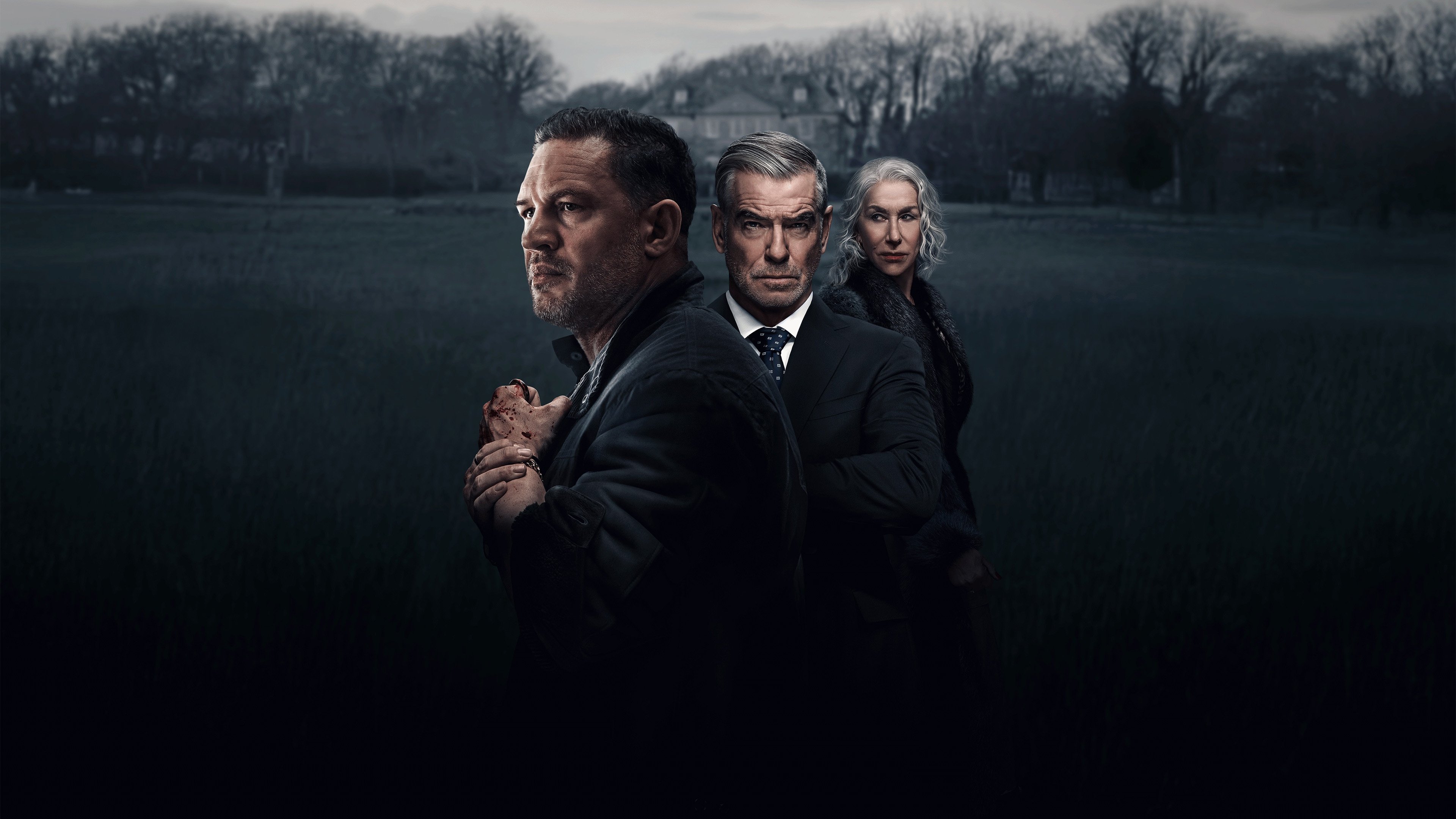
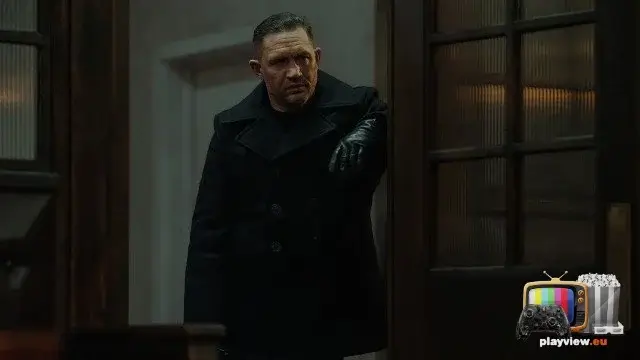
I also liked the contrast between Harry's composure and Conrad's impulsiveness. One tries to contain the damage, while the other often reacts as if he needs to prove to everyone that he is still the strongest person in the room. Pierce Brosnan portrays this dangerous side of Conrad in a way that keeps the character unpredictable, while Tom Hardy continues to give Harry a restrained intensity that doesn't need many words to work.
The episode also manages to connect the criminal conflict with the protagonist's personal life. Frankie's attack is not just another move against the Harrigans. It is an attempt to destabilize Harry, to force him to react emotionally and, potentially, to make mistakes that under normal circumstances he would avoid.
The initial reviews for the episode are not entirely unanimous. Ready Steady Cut feels that "Blank Curtain" loses some of its pacing as it divides its time across multiple parallel storylines and saves the strongest developments for the final act. In contrast, Seat42F focuses on the transformation of Harry's loyalty into a weakness and the way internal family tensions make his position increasingly difficult.
I understand the objection regarding the pacing. There are quite a few open fronts, from Ireland and Seraphina to the police investigation and the war with Frankie. Some of these need more time to reveal their true purpose. For me, however, this accumulation of storylines suits the nature of MobLand. Harry does not have the luxury of dealing with only one problem at a time, because every time he turns in one direction, someone else moves against him from another.
The episode doesn't offer all the answers I would like, but it raises enough new questions to keep me invested in the story. And, personally, I prefer an episode that carefully sets up the next moves over one that plays all its cards at once without leaving anything for the future.
The episode makes great use of the idea of hidden moves and information that isn't available to everyone, as the characters try to figure out what their opponents are planning.
Tom Hardy's character remains the man who is called upon to fix the messes created by others. His effectiveness is simultaneously his greatest asset and the reason he is becoming increasingly indispensable — and therefore more exposed.
The fourth episode of the second season was, for me, a very nice episode. I enjoyed it, mainly because it continues to build the conflict around Harry, without forgetting that real threats do not always come from where you expect them to.
Conrad chooses to answer with blood. Frankie strikes where it hurts the most. Maeve continues to move her own pawns, while Seraphina enters a game that may prove to be much more dangerous than it seems. And Harry is caught in the middle, trying to maintain control of a situation that is becoming increasingly personal.
The interesting thing is that Harry can anticipate several of his opponents' moves, but he cannot control the choices of the people close to him. And the more his opponents realize that his family is the point where he can be hurt, the more difficult his position becomes.
The game continues, then. The question is not only who will make the next move, but who will force Harry to play by their rules.
Because, until now, Harry has been the one solving everyone else's problems. What will happen when his own problem becomes larger than what he can handle?
Overall, then, a very good episode, with clever moves, mounting tension, and a finale that shifts the conflict from the criminal chessboard to Harry's personal life. The series continues to patiently build toward the showdown, leaving several questions open for the future.


