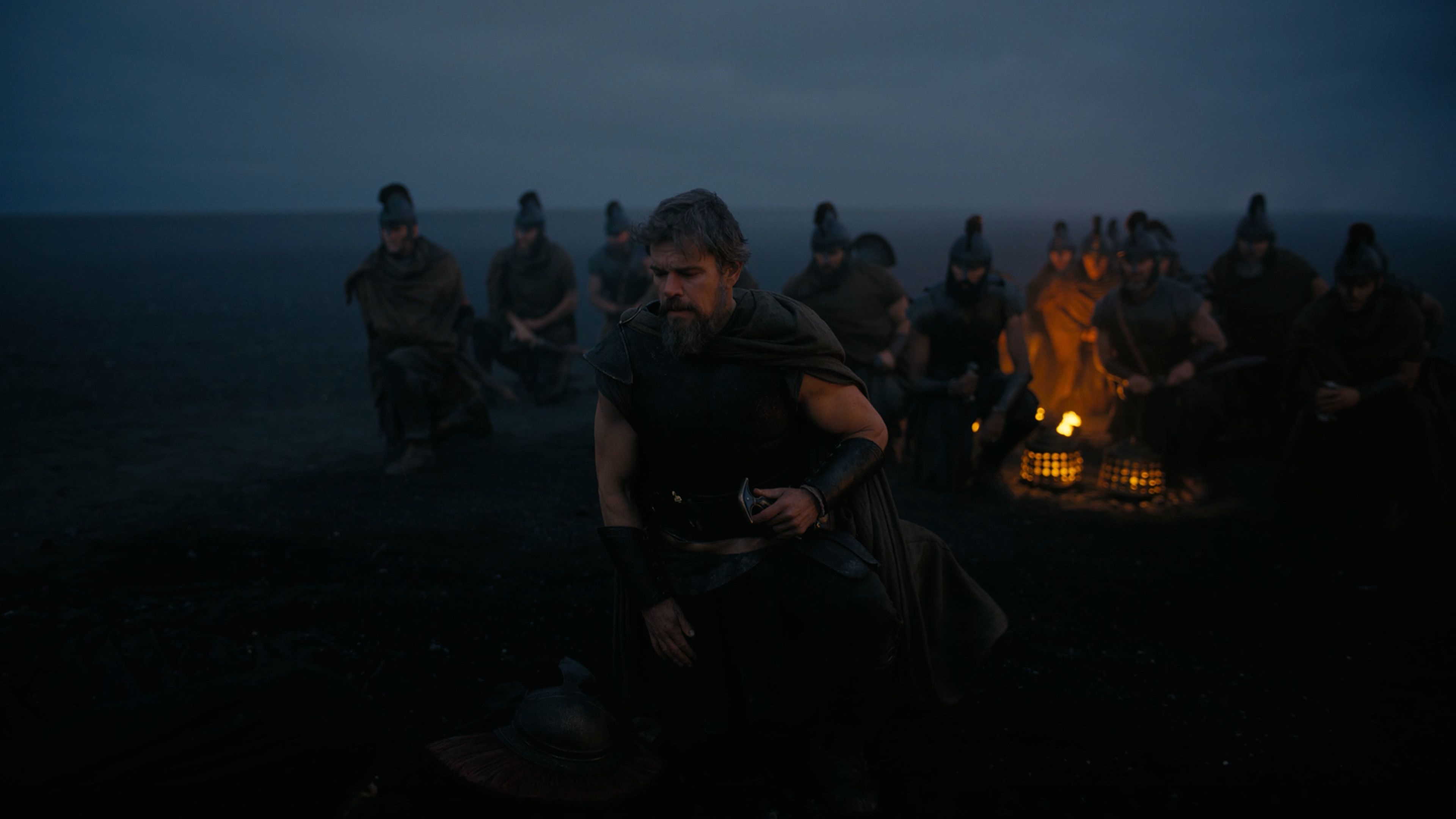
MY VIEW · UPDATE
Christopher Nolan's Odyssey — A journey that I ultimately enjoyed very much
Odyssey · 13/09/2026
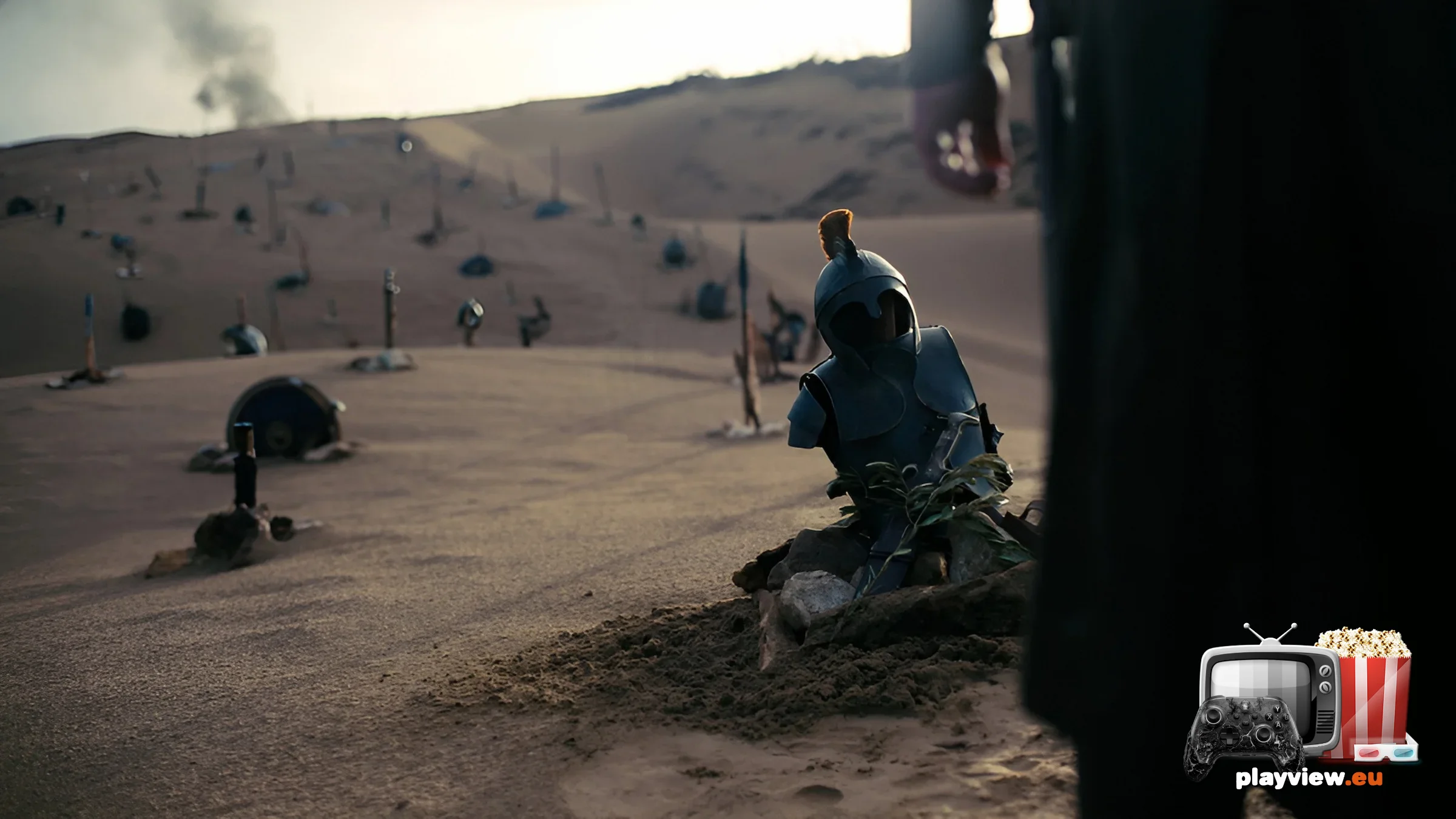
There is a very specific reason why I wanted to see Christopher Nolan's The Odyssey in a cinema rather than simply wait for it to eventually appear on a streaming platform. From the moment the film was announced and the first images started appearing, I had it in my mind as one of those cases where the big screen isn't simply preferable, but is actually part of the experience itself. So I wanted to see it in IMAX and, specifically, to sit as centrally as possible. The problem was that demand in Athens was enormous from July onwards and the good seats disappeared very quickly, so I eventually had to wait until September. Last night, September 12, I finally went to the IMAX at Village Cinemas in The Mall Athens, in Marousi, and I can say from the start that, although I had heard a lot about the film, the big-screen experience was exactly what I had hoped for.
And there is a reason for that. The cinema at The Mall Athens is the first IMAX with Laser auditorium in Greece and uses a 4K laser projection system, offering much higher clarity, contrast and brightness than a conventional digital projection, accompanied by IMAX's dedicated multi-channel sound system. The screen is enormous, curved and designed to fill much more of your field of vision than a standard cinema screen.
And here we need an important clarification, because when we say "IMAX", we aren't always talking about exactly the same thing. The Odyssey is the first feature film shot entirely with IMAX film cameras, using the enormous 15/70 format, and the ultimate presentation is in cinemas capable of projecting the actual IMAX 70mm film. There are only around 40 such cinemas in the world, and there isn't one of them in Greece.
What I saw in Marousi was IMAX with Laser, meaning 4K laser digital projection rather than projection of the original 70mm IMAX film. That absolutely does not mean that it isn't real IMAX; it is a different projection system within the IMAX family. It simply isn't the same as watching the original 15/70 film in one of the very few cinemas in the world capable of projecting it. And honestly, after what I saw last night, I have absolutely no complaints. The image, the size of the screen, the brightness, the clarity and, above all, the way Nolan's enormous images occupy your field of vision make a huge difference compared with a conventional cinema. IMAX itself announced that the film set box-office records for the company and that more than 26% of its worldwide box office came from IMAX screenings.
And this is something I want to establish from the beginning, because it isn't a minor detail. The Odyssey is a film you should see in the best cinema you can find. I'm not saying that if you watch it in a regular cinema you will lose the film, but you will certainly lose part of the way it was designed to be experienced.
And now that we've established that, let's get to the film itself.
I didn't go to watch a History lesson
From the beginning, I want to clarify something else, because there has been a lot of discussion about the changes Nolan made to Homer. Personally, they don't bother me.
I don't expect a movie to teach me History or Greek mythology. I know the story of Odysseus, I know what Homer wrote and I know that The Odyssey isn't a screenplay written for Christopher Nolan so that he could simply transfer it to the screen. It is an epic that is thousands of years old and, obviously, every filmmaker attempting to bring it to the screen today has to decide what to keep, what to change and what to leave out.
Nolan himself has explained that he wanted to tell the story in a fresh and contemporary way, so that it would be accessible to today's audience in the way Homer was accessible to the audience of his own time. And that choice is visible throughout the film.
So I didn't sit in the cinema to check its historical accuracy. I sat there to see whether Nolan could take The Odyssey, make it his own and give me a cinematic experience that would hold me for almost three hours.
And, for me, he did.
The "Beautiful" Helen and the previous conversation
There is one point I want to connect with the previous article I wrote, because it wouldn't be right to ignore it. I had talked then about Helen and the fact that Nolan's particular choice didn't create the same image in my mind that I had from previous cinematic adaptations.
And especially from Troy by Wolfgang Petersen, where Helen was played by Diane Kruger.
I won't fall into the same trap again and make the actress's appearance the central issue of the discussion. For me, that isn't what determines a film like this. I may have had a different image of Helen in my mind, but that doesn't mean Nolan is obliged to film my version of her.
I was much more interested in what he was going to do with Odysseus himself.
The opening narration didn't win me over
And the truth is that, at the beginning, I was a little worried.
The way the film starts, with Odysseus on Calypso and the narration taking us through events that have already happened, wasn't something I particularly liked. I prefer to see events happen in front of me and discover them together with the characters, rather than have someone explain what happened and then watch it in flashback.
For a while, I thought this might be the structure of the entire film and that I would spend a large part of it watching a story being told within a story.
But Nolan eventually found a way to make it work.
The film begins to move, it goes to Troy, returns to Odysseus, opens up his journey, moves through the different episodes and gradually all of these pieces begin to acquire greater meaning. And at some point I stopped thinking about the structure and simply started watching.
That is perhaps the biggest compliment I can give the film.
It took me with it.
Nolan managed to turn The Odyssey into an adventure
The Odyssey runs for approximately 2 hours and 53 minutes, but personally I never felt that runtime weighing on me. Matt Zoller Seitz at RogerEbert.com even notes that the film feels shorter than its 172 minutes because Nolan and editor Jennifer Lame treat time not as a straight line but as a map where moments can return and acquire different meanings.
That is exactly how I felt.
The story constantly shifts, but I never felt that it lost its direction. From Troy to Calypso, from the Cyclops to Circe and from there to Ithaca, there is a sense of journey that personally won me over.
And this is where I completely understand those who loved it.
Peter Bradshaw of The Guardian gave it 5/5, describing it as a film of enormous ambition, daring and visual grandeur, while particularly praising the scale of its images and battles.
Guy Lodge of Variety was also highly positive, although with an interesting reservation: he considers the film more sensory than emotional and believes there is a certain distance from the characters.
Matt Zoller Seitz of RogerEbert.com, meanwhile, focused particularly on the structure and the way the film handles time, believing that the shifts in chronology work in its favor.
David Rooney of The Hollywood Reporter was considerably more cautious. He recognized the technical achievement and enormous sets, but felt that certain sections, particularly Odysseus's scenes with Calypso, interrupt the flow and that the film is structurally awkward in places.
And this is where I find myself closer to the first group than the second.
Cyclops and Circe
One of the scenes I genuinely enjoyed was the Cyclops. And it's not only because the creature is impressive. It's the way it has been filmed, the way it moves through the space and the way Nolan uses scale to make you feel that these people are actually facing something much larger than themselves.
Bill Irwin, who plays the Cyclops, has extensive experience in physical theatre and movement, and that shows in the way he portrays the creature. Even reviews that didn't love the film acknowledged the work that went into it. The Boston Globe, for example, singled out the Cyclops as one of the moments where the film really works.
And then there is Samantha Morton's Circe, which I also liked very much. The scene in which she transforms Odysseus's men into pigs is exactly the kind of spectacle I want to see in a film like this. Not everything needs to be profound. Sometimes I simply want to see an excellent cinematic effect, enjoy it and continue with the story.
And this part of the film did that very well.
And the Laestrygonians that had confused me
There was one image I had seen in the film's promotional material that I couldn't understand which part of The Odyssey it referred to. Those enormous figures in white or silver armor chasing Odysseus's men.
It turns out they are the Laestrygonians.
And this is one of the pieces of trivia I liked most, because it proves that despite Nolan's changes, some of the strangest things we see in the film really are rooted in Homer.
The Laestrygonians appear in Book 10 of The Odyssey and are a race of giants and cannibals. When Odysseus and his companions reach their land, the Laestrygonians attack the ships, throw enormous rocks and destroy almost the entire fleet. In the end, only Odysseus's own ship escapes.
So that scene where I was wondering "what the hell are these guys?" wasn't unrelated to the epic at all. Nolan simply took the idea and gave it a very different cinematic form.
And here comes the spoiler
⚠️ SPOILER ALERT — From here on I am talking openly about the ending of the film. If you haven't seen it, stop here and don't click to read further.
For me, the best part of the film is the final section.
And honestly, I can't understand why I've heard so many people tell me that the ending was bad.
When the moment finally arrives for Odysseus to return to Ithaca and confront the suitors, I felt that the entire film had been leading exactly there. You've seen what happened in Troy, you've seen what Odysseus carries with him, you've seen the situation in Ithaca and you've been waiting for his return.
So when he takes the bow and starts killing them, I was completely invested in the scene.
And I actually loved the length of it.
I can't remember another similar scene lasting this long, where a hero returns after such a long journey and the film essentially tells you, "now you're going to sit and watch this."
It doesn't rush.
Odysseus reveals himself to the suitors, takes back his home and begins his revenge. And as the scene develops, you increasingly feel that he has finally returned.
Personally, I thought it was incredible.
And visually I liked it even more. In IMAX Laser, on that enormous screen, the scene had real weight. The movement, the arrows, the violence, the reactions of the suitors, all of it filled the screen in a way that, honestly, I don't know if it would have had the same impact for me in a regular cinema.
And this connects to something else that I think is important: Athena.
The way the film uses her statue, its destruction in Troy and then her presence through Odysseus's dreams and hallucinations creates a motif that runs throughout the entire film. Athena isn't simply a character who appears to tell him what to do. She is more like a presence that follows him and judges him.
And the moment when Odysseus cuts the head off her statue in Troy takes on even greater weight once you reach the ending.
Because this entire return isn't only about whether Odysseus will reach Ithaca. It is about who he will be when he gets there.
And that, in my opinion, is one of the most interesting things Nolan did with the original material.
He didn't simply want to show us a hero returning home.
He wanted to show us a man returning after twenty years of war and wandering, having to confront everything he has carried with him.
Did you know the entire film was shot in IMAX?
This is perhaps the most interesting piece of trivia in the film and has even more significance considering that I watched it in IMAX.
The Odyssey is the first feature film shot entirely with IMAX film cameras. Christopher Nolan and cinematographer Hoyte van Hoytema used more than 600 kilometers of IMAX 70mm film for the production.
Nolan even had to work with IMAX to create a smaller and quieter camera because standard IMAX 70mm cameras are so loud that they create problems during dialogue scenes. A new camera was specifically developed for the film so that it could shoot even very close and quiet scenes on IMAX film.
And there is another impressive number: in the IMAX 70mm version, the approximately 2 hours and 53 minutes of the film correspond to around 17.7 kilometers of film.
That helps explain why the production was so difficult and why this particular film was treated from the beginning as a cinematic event rather than simply another blockbuster.
Another piece of trivia I liked
Nolan didn't want to treat The Odyssey like one enormous digital set. He filmed on real locations and tried to create as much as possible in front of the camera because he wanted the actors to actually feel the scale and difficulty of the world they were inhabiting.
You can see this particularly in the scenes with the ships, battles and creatures. And it is probably one of the reasons why, even when you see a huge mythological creature, you don't always have the feeling that you're simply looking at a digital effect.
And the film has already become a huge box-office success
From a commercial perspective, The Odyssey no longer needs much defending.
By early September it had passed $1.6 billion worldwide, with the latest available figures putting it at around $1.68 billion. Of that, approximately $601 million came from the United States and Canada and around $1.08 billion from international markets.
It has therefore become the biggest box-office success in the history of Universal Pictures, while also becoming the highest-grossing film of Nolan's career.
Even more impressive is the IMAX result. The film has passed $289 million from IMAX screenings alone and became the highest-grossing film in IMAX history, while IMAX screenings accounted for more than a quarter of its worldwide box office.
And that is genuinely impressive when you consider that we're talking about a cinematic adaptation of an ancient epic rather than a superhero franchise.
So what did the critics ultimately say?
The overall reception was extremely positive. Rotten Tomatoes currently has The Odyssey at 94% from critics and 96% from audiences, with more than 500 critic reviews and over 25,000 verified audience ratings.
Peter Bradshaw of The Guardian gave it five stars and described it as a film of enormous ambition, with impressive cinematic scale and strong emotional dimension.
Matt Zoller Seitz of RogerEbert.com focused particularly on the film's structure and the way Nolan handles time, arguing that the film feels shorter than its runtime precisely because the narrative repeatedly returns to events and gives them different weight.
Guy Lodge of Variety was also positive, but observed that the film works more on a sensory level than a deeply emotional one, with a slight distance from its characters.
David Rooney of The Hollywood Reporter was more critical, considering it uneven and structurally awkward in places, while also criticizing some of the dialogue, which he found anachronistic.
There was even a much harsher reaction from Emily Wilson, the academic and translator of The Odyssey, whose translation Nolan used as one of his key references. Wilson argued that the film lacks psychological and moral depth and ultimately invests more in spectacle than in its characters.
And that is interesting because it shows the exact difference between evaluating the film as a cinematic adaptation of an ancient work and evaluating it as a cinematic experience.
I am clearly much more on the second side.
And ultimately?
I won't say The Odyssey is perfect. It isn't. There are choices I didn't like, the opening narration with Calypso didn't win me over immediately and I completely understand why some viewers found certain sections too long or emotionally distant.
But what the film gave me was exactly what I expected from a major cinematic production. Entertainment.
It had the Cyclops, which I liked enormously, it had Circe and her impressive effects, it had the Laestrygonians that I eventually learned really do come from Homer, it had Odysseus's journey, it had some great transitions, it had a Matt Damon whom I personally really liked in the role and, above all, it had a flow that never made me feel its enormous runtime.
And then it had that ending.
The moment Odysseus returns, reveals himself to the suitors, takes the bow and starts taking them apart, I was exactly where the film wanted me to be. And when all of that connects with Troy, Athena, the dreams, the guilt and the way Odysseus returns to Ithaca, I think Nolan brings his own version of the journey together very well.
And there is something else that may sound strange, but it matters to me: I don't want to leave a film having simply acknowledged that it was well made. I want to have had a good time.
Last night, in the IMAX Laser auditorium in Marousi, I did.
I watched that enormous screen fill with Troy, the sea, the creatures, the battles and finally Ithaca, I heard the sound fill the entire auditorium and, for almost three hours, I watched a man trying to get home.
It may not be the Odyssey a classicist would choose.
It may not be the most faithful adaptation of Homer.
It may not appeal to everyone.
But I liked it. And I genuinely enjoyed it.
And, ultimately, after a journey of almost twenty years for Odysseus and a wait since July for me, perhaps that was all I wanted from this film.


