
S03E05-E06 | The Return of Celeborn, Sauron’s Games, and the Price of Power

Episodes 5 and 6 dropped on Wednesday, November 18. I watched them the same day, but work got in the way before I could get a review written. The show continues to maintain a high bar, featuring great battle sequences, incredible landscapes, and tons of tension. There were a few things I didn't like, but I'll circle back to those at the end of the article.
As always, let’s first take a look at some details from the episodes.
Spoilers: The Lady of Lórien – Episode 5
The fifth episode begins with Sauron trying to extract information from Marnukh, the Orc who helped Galadriel and Arondir in Gundabad. Sauron threatens his family and eventually learns that Galadriel and Celeborn are heading toward Eryn Galen, the forest that will later become Mirkwood. Marnukh fails to protect his children, while Sauron continues pulling the strings, using fear and loss as tools of control.
Meanwhile, Galadriel and Celeborn try to escape the Orcs, finding shelter high up in the trees. There, amid the tension of the pursuit, they have a chance to talk about everything that has happened over the years. Galadriel is forced to confront her guilt as she realizes that she spent centuries hunting the evil she believed had taken her husband from her, rather than trying to find him.
This moment adds a more personal element to her story. Galadriel admits that her obsession with Sauron had become a way to avoid the pain of her loss. Celeborn, on the other hand, reveals that he survived the Orcs’ captivity and torture by keeping the memory of his wife alive.
The calm, however, doesn’t last long. Galadriel dreams of Sauron, who appears in the form of Halbrand. The disturbance caused by the dream leads her to fall from their shelter and lose consciousness. When the Orcs approach, Celeborn surrenders to protect her. Sauron appears and takes him away, knowing that Galadriel will do anything to save him.
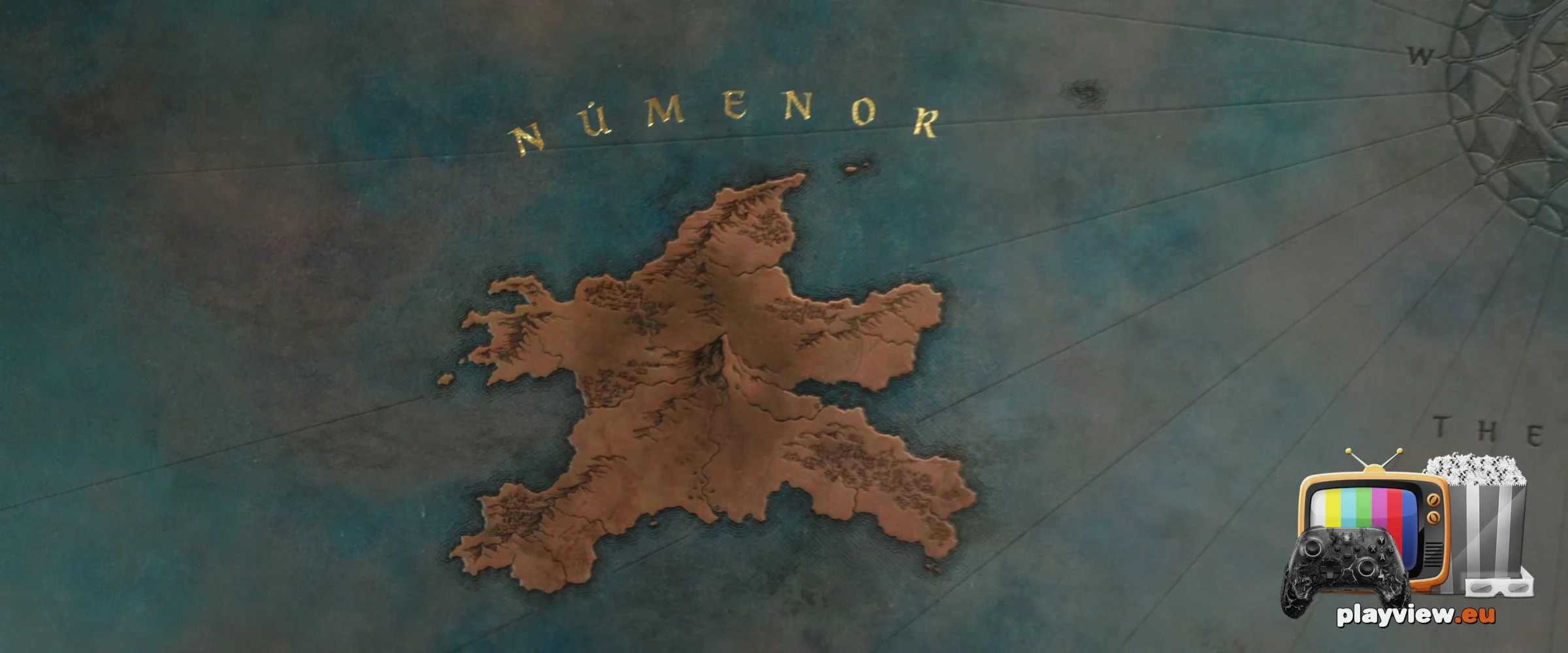
In Númenor, the political situation remains explosive. Elrond and Gil-galad arrive in the kingdom, hoping to prevent a civil war between the King’s Men and the Faithful. Pharazôn, however, is not prepared to give up his power. He tries to take advantage of Míriel’s need for help, proposing an agreement that could unite the kingdom, but at a very high personal cost to her.
Elrond meets Isildur and tries to convince him that the sacrifice of Elros and the history of Númenor should not lead to another cycle of bloodshed. Meanwhile, Elendil gathers the Faithful, and the tension between the two sides of Númenor becomes increasingly dangerous.
At the same time, Gandalf tries to prevent the war from spreading across Middle-earth. His efforts, however, do not unfold as he hoped, and he ends up in a difficult position. The episode closes with Sauron having regained control of events, while Galadriel faces the loss of Celeborn for a second time.
Spoilers: From Valinor – Episode 6
The sixth episode continues with Galadriel trying to escape the Orcs in Greenwood. The situation changes when Theo appears, having finally realized that the ring Sauron gave him is destroying him. He cannot remove it on his own and asks for her help. Galadriel manages to take it off, but Theo has already paid a heavy price for choosing to trust Sauron.
Theo reveals to her that Celeborn is alive and being held in Mordor. Galadriel decides to save him, and Theo follows her. The two travel through the forests that will one day become Lórien, where one of the most meaningful conversations of the two episodes takes place.
Galadriel explains that she spent centuries hunting the darkness because it was easier than facing the loss of Celeborn. Theo, who has lost his mother and Arondir, understands exactly what she is describing. Their relationship therefore takes on a new dimension: Theo is no longer simply a character who needs to be saved, but someone who can understand Galadriel better than many of her allies.
In Mordor, Sauron tries to extract the secret of the Three Elven Rings from Celeborn. Physical and psychological pressure are not enough, so Sauron decides to play with his mind. He talks to him about Galadriel, trying to make him believe that she abandoned him and chose to hunt Sauron rather than search for her husband.
Celeborn resists for quite some time, but Sauron manages to push him to his limits. Eventually, he appears before him in Galadriel’s form, pretending that he has come to rescue him. Celeborn believes that his wife is finally standing before him and reveals that the Three Rings were created from the gold and silver of Valinor that came from the dagger of Finrod, Galadriel’s brother.
This revelation is exactly what Sauron needed. He now learns the secret behind the creation of the Three Rings and turns his attention to Fëanor’s hammer, which he needs to forge the One Ring. The only thing that can melt it is the fire of Mount Doom. This revelation further connects the series’ story with the events we know from The Lord of the Rings.
In Khazad-dûm, Thráin continues his search for the Seven Rings and threatens Disa’s children to force her to use her gift for stone-singing. Disa appears to give in, but in reality she leads his men into a trap that allows her to get closer to Durin. Their reunion is one of the episode’s most powerful moments, as Disa once again proves that her love for Durin and their children is stronger than fear.
In Númenor, Elrond and Gil-galad try to prevent a civil war, while Elendil and Isildur find themselves on opposite sides over how Pharazôn should be dealt with. With Gil-galad’s help, Míriel regains her sight and meets Pharazôn. He proposes a political marriage to unite Númenor, a move that once again changes the balance of power and leaves Elendil racing toward the capital to stop events from unfolding.
What Are the Critics Saying?
The picture emerging from the first reviews is positive, but not universally enthusiastic. On Rotten Tomatoes, both the fifth and sixth episodes have a 100% score from critics, with five reviews for each. That does not mean, of course, that everyone considers them masterpieces; the percentage shows how many critics gave a positive review, not how high their ratings were.
Jim Vejvoda of IGN gave the two episodes a 7/10, noting that after the intense action of the first four episodes, the series seems to lose some of its momentum. His review aligns quite closely with my own feeling about the narrative back-and-forth and the delay of certain developments.
On the other hand, Kshitij Rawat of TV Fanatic gave them 4/5, emphasizing that the storylines are finally beginning to converge and that Sauron’s threat makes the episodes difficult to walk away from. Sarah Novack of Tell-Tale TV also gave them 4/5, highlighting Elrond’s development and the importance of Galadriel’s relationship with Celeborn. Matt Schimkowitz of AV Club was more reserved, giving the sixth episode a B-, while acknowledging that the series gives its characters more room rather than relying exclusively on the plot.
Overall, critics seem to agree that the third season has improved its focus and that the characters are gaining greater depth. At the same time, concerns remain about the pacing, the many parallel storylines, and the series’ tendency to delay certain developments. For me, these two episodes are a good example of both sides: the series is still impressive, but it does not always make the most of its material.
Why Are the Final Two Episodes Coming Out Earlier?
Amazon announced that episodes 7 and 8 will be released together on Wednesday, November 25, with the release time moved six hours earlier than usual. The change means that viewers in the United States will be able to watch the finale six hours earlier than they normally would.
The shift is connected to the holiday season and the production’s desire to wrap up the season before the holidays, allowing viewers to watch the final episodes together. Co-creator Patrick McKay had said that releasing episodes in larger batches was intended to bring the season to a close before the holidays, giving families and groups of friends the opportunity to watch it together.
For Greece, this change means that the final two episodes will be available in the early hours of Wednesday, November 25, at 04:00 Greek time. The change affects the release time, not the content or runtime of the episodes.
The Forging of Season 3 – Behind the Scenes
Unfortunately, Amazon had not released the The Forging of Season 3 episodes for episodes 5 and 6 on YouTube. However, both are now available through Prime Video, running six and seven minutes respectively.
If you haven’t watched them, I recommend checking out the previous episodes as well, which you can find in the Media section. They offer a great look at the filming, set construction, costumes, and the way everything we see on screen is created. They are the kind of small additions that make the experience of the series even more interesting, especially when you have already been impressed by its visuals.
Trivia
Celeborn was not dead in the books.
In Tolkien’s works, Galadriel and Celeborn have been married since the First Age and have already had their daughter, Celebrían. The series chooses to portray Celeborn as missing for a long time, creating a personal quest that does not exist in the same way in the books. His captivity under Sauron and the torture he endures are additions made for television.
Elros was the first King of Númenor.
Elros and Elrond are twin brothers, the sons of Eärendil and Elwing. At the end of the First Age, the two brothers had the opportunity to choose between the fate of Elves and Men. Elrond chose the immortality of the Elves, while Elros chose to become a Man and live as a mortal. He became the first King of Númenor and lived for 500 years. The fifth episode’s reference to Elros’s choice is a direct connection to Tolkien’s material.
Lórien is more than just a forest.
Lórien is the Elven kingdom we will later encounter in The Lord of the Rings. The region holds particular significance for Galadriel and Celeborn, as they will settle there and rule. The series uses Galadriel’s visit to the forest as a way to connect her personal story with the future creation of the kingdom.
Sauron doesn’t always need an army to win.
Using Galadriel’s form to deceive Celeborn is an addition made for television, but it is based on something fundamental to Sauron’s character: his ability to manipulate others. In the books, Sauron uses persuasion, deception, and his knowledge of other people’s weaknesses to make them serve his purposes. The series transfers that power into a personal story, with Celeborn becoming his next victim.
The One Ring was created at Mount Doom.
In the books, Sauron forges the One Ring in the fires of Mount Doom, in Mordor. Fëanor’s hammer, which appears in the series, is not a known tool used in the creation of the Ring in Tolkien’s writings. The series uses it as another link between the Three Elven Rings and the One Ring, giving Sauron a specific goal for the coming episodes.
The Elven Rings were not created by Sauron.
In the books, the Three Elven Rings were created by Celebrimbor, without Sauron ever touching them. Nevertheless, Sauron’s power is connected to their creation, as he had already helped the Elves develop the craft of Ring-making. The series chooses to present the secret of their materials as information Sauron can use to forge the One Ring.
My View – When the Story Goes in Circles
Writing-wise, I wasn't a fan of the logic in episode 5. Galadriel and Celeborn head off into the unknown on a wing and a prayer, as the Greek saying goes, only for Sauron to capture Celeborn once again, who surrenders himself just so Galadriel won't get caught. Personally, this endless loop of escape, capture, and escape again makes it feel like the story is going in circles rather than actually moving forward.
From a storytelling perspective, I didn’t like the logic of the fifth episode. Galadriel and Celeborn head into the unknown, with hope as their only guide, as the Greek proverb goes, and eventually Sauron captures Celeborn again. He surrenders himself so that Galadriel won’t be captured. Personally, this constant cycle of escape, capture, and another escape gives me the impression that the story is going in circles rather than making meaningful progress.
I expected Sauron to play with Celeborn’s mind to extract the secret of the Rings from him from the very beginning. It is a tactic he has used repeatedly, whether with the Orc who helped them or with so many other characters who have crossed his path. So it wasn’t the revelation itself that bothered me, but how predictably we arrived at it.

On the other hand, Theo’s decision to remove the ring was a development that gave me pause. In episode 4, he had just killed Arondir and surrendered himself completely to Sauron, but now he seems to change course without us having seen enough of his inner conflict. I would have expected to see him tormented more by nightmares, guilt, or memories of what he had done, so that his decision would carry greater weight. The series shows us his change, but it doesn’t let us experience it as much as I would have liked.
Despite these reservations, my overall view of the two episodes remains positive. The series continues to deliver excellent visuals, impressive landscapes, powerful action scenes, and plenty of tension. Galadriel and Celeborn’s story now carries real personal weight, while Sauron remains the most interesting character in the series.
The problem is that, in certain places, the writing seems to delay developments, as though it needs to fill time before reaching the point it is actually aiming for. I hope the final two episodes make the most of everything that has been built so far and give us a finale worthy of the season’s overall quality.


