
We grew up with Papakaliatis. And now the whole world is watching him!

For those of us slowly approaching our 50s, Papakaliatis is a name we have grown up with. TV series we loved, stories that kept us talking, romances we discussed, and films that were always a topic of conversation. When it was announced that he would be returning with a new series, where else but on MEGA, we all knew it would be something worth talking about! We knew, for example, that it would have incredible production values and quality, because Christoforos pays great attention to these things. Success was practically guaranteed.
We also had some surprises when it came to the casting. Our beloved Haris Alexiou a voice we associate with some of the most important Greek songs, makes her debut as an actress in a TV series and SHE ABSOLUTELY ROCKS! She is incredible in her role. Papakaliatis' eye for casting, his instinct that this great singer could actually become the grandmother we get to know through the series, proved absolutely spot-on once again. And alongside her, a new muse, Klelia Andriolatou, captivates us with her rare beauty and screen presence.
A series that tackles so many issues in our society and makes you watch sometimes with a smile, sometimes in complete silence as the drama unfolds before your eyes, and sometimes with tears in your eyes. That is why, I believe, the opportunity for the series to make it onto Netflix came naturally, becoming the first Greek scripted series to achieve this major milestone. I will not go into the subsequent seasons here. I will return with a new article.
From Na Me Proseheis to Maestro
Before we head to Paxos, it is worth taking a moment to look back at Christoforos Papakaliatis' journey. Because Maestro did not suddenly appear out of nowhere. It is the result of a career that began long before Greek television started talking so extensively about cinematic visuals, international distribution, and productions capable of standing alongside foreign series.
We first got to know him as an actor at a time when private television was shaping its own identity. From Aparadektoi and Dolce Vita to Anastasia, his presence became associated with a generation of actors and creators who grew up alongside the new television landscape. Gradually, however, he began developing his own creative voice, writing stories centred on human relationships, forbidden desires, and the decisions that can change a life.
I Zoi Mas, Mia Volta and Na Me Proseheis were important milestones along this journey. With Kleise ta Matia, he developed his personal style even further, while Dyo Meres Mono and 4 showed a creator who wanted increasingly greater control over how his stories reached the screen. Romance, family relationships, social prejudices, and the constant conflict between what we desire and what society considers right became the building blocks of his work.
In cinema, An... (2012) and Worlds Apart (2015) demonstrated even more clearly his ambition to bring his personal universe to the big screen. An... explored the different versions of a life that can change because of an apparently insignificant decision, while Worlds Apart brought together three love stories against the backdrop of Greece's economic crisis and the social tensions of the time. It was a film that attempted to look at the country beyond the narrow confines of a love story.
All these works shared one common element: Papakaliatis loves creating worlds in which the personal becomes political and social. His characters' relationships do not exist in isolation from their surroundings. They are influenced by family, politics, economic circumstances, prejudices, and social expectations. This is exactly what we find in Maestro, only this time the scale of the production and the directorial approach raise the bar.
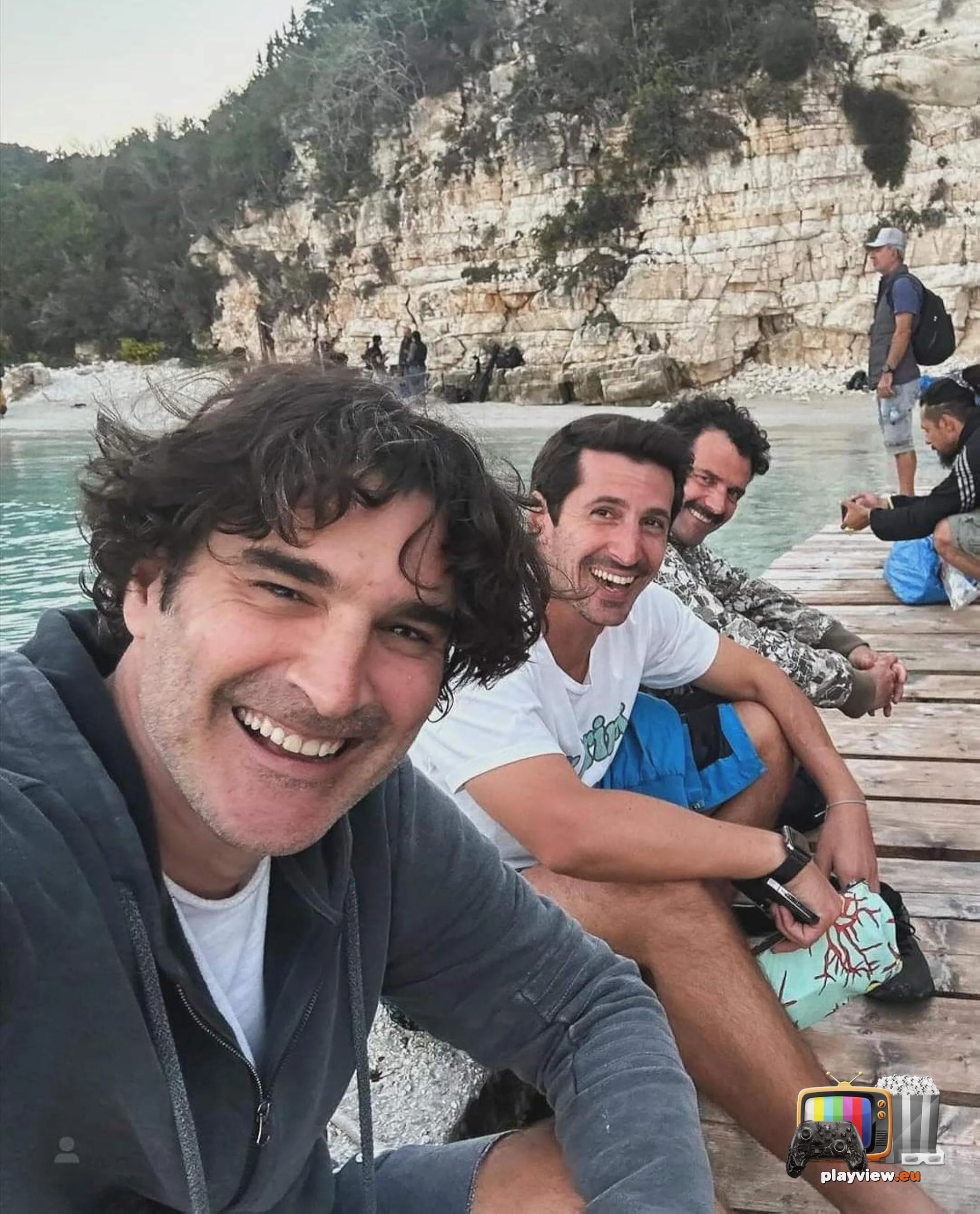
A Music Festival in Paxos and a Society Full of Secrets
The story begins when Orestis, a musician looking for an escape from his life in Athens, arrives in Paxos to take charge of reorganising a music festival. The pandemic and the lockdown period form the backdrop of the narrative, with isolation serving as a reason for people to come closer together while also forcing them to confront the things they have avoided for years.
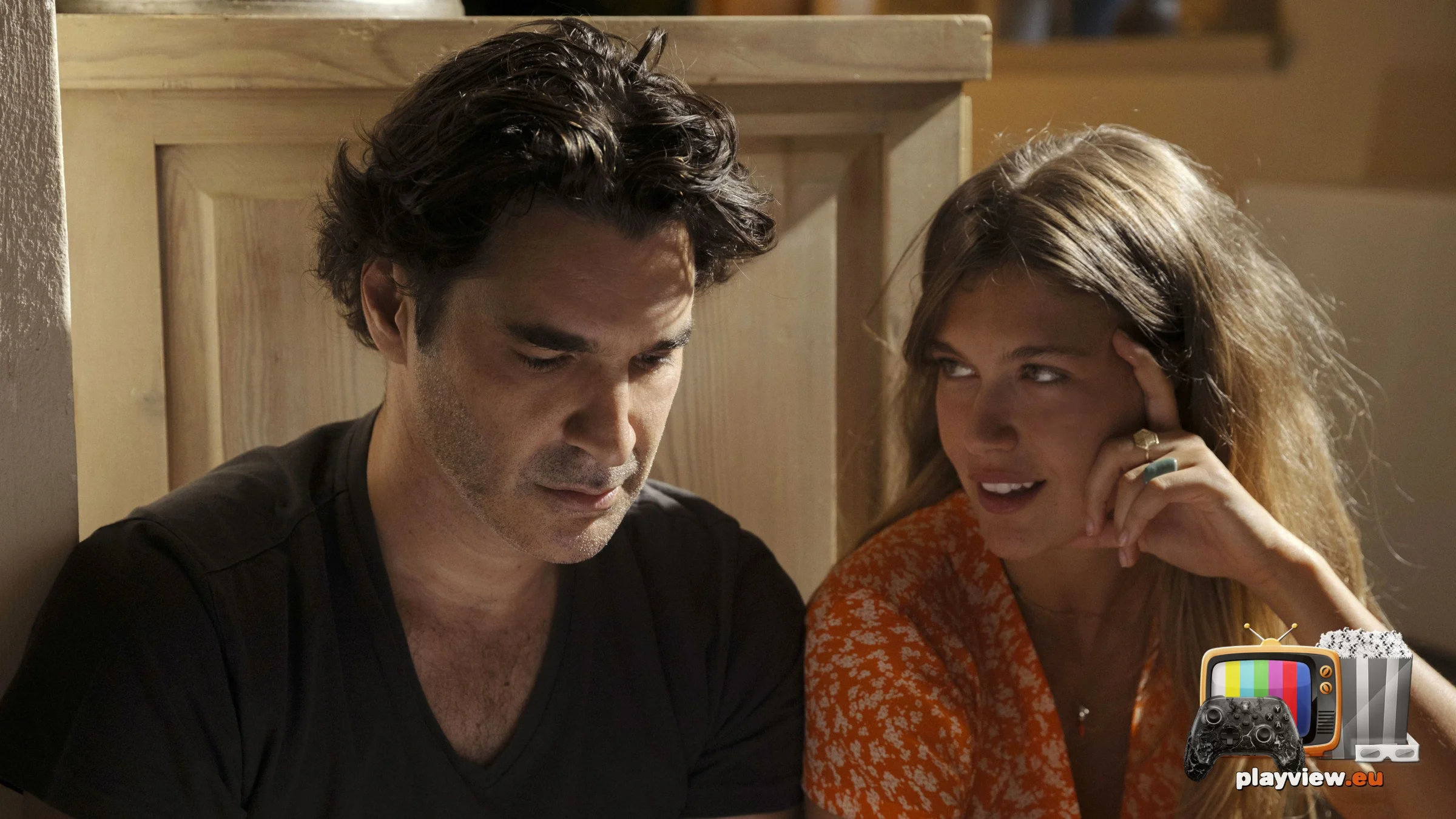
There, Orestis reconnects with Klelia, a young woman who dreams of escaping the island's narrow confines. Their relationship develops into a romance charged with emotion, but it also raises questions about their age difference, power dynamics, and the expectations they each carry. Klelia wants to discover the world and live on her own terms. Orestis, meanwhile, sees the island as an opportunity to distance himself from a life that no longer satisfies him.
The festival provides the catalyst that connects the stories of the island's residents. Behind the beauty of Paxos lies a small community where everyone knows everyone, everyone has an opinion about everyone else, and public image often matters more than personal happiness. Political ambition, domestic violence, homophobia, and secret relationships are not simply parallel storylines. They are pieces of the same social fabric, which begins to unravel as the characters struggle to keep their secrets hidden.
Paxos is perhaps the series' most important character after the people who inhabit it. The lush green landscapes, narrow streets, little harbours, and waters of the Ionian Sea create a picture that could easily belong in a tourist brochure. Papakaliatis, however, uses this beautiful setting to tell a story filled with tension. The tranquillity of the landscape contrasts with the violence taking place inside people's homes and the secrets the island's residents are trying to conceal.
This contrast works exceptionally well. The island becomes a microcosm of Greek society, where tradition and social conventions clash with the need for freedom. The fact that everyone knows one another does not mean they truly know each other. In fact, knowing other people's secrets often becomes a form of informal power, with people choosing silence to preserve the existing balance.
Haris Alexiou: A Great Voice Discovering a New Side of Herself
Haris Alexiou's participation was one of the most pleasant surprises of the first season. An artist who has left her mark on Greek music through her voice and performances steps in front of the camera in a different role and manages to win over audiences with her naturalness and authenticity.
Haroula, as she is known in the series, is a woman with humour, sensitivity, experience, and a deep understanding of the people around her. She can comment on a situation with a line that makes you laugh and, just a few minutes later, move you without ever needing to raise her voice. Her presence offers a humanising balance in an environment full of tension.
What I like most is that Papakaliatis does not treat her as a famous singer making a guest appearance in a series. He gives her a fully developed character, with her own relationships, feelings, and contradictions. The casting choice proves inspired because her personality suits the role, while her musical experience adds a distinctive dimension to a series in which music is a fundamental part of the storytelling.
Klelia Andriolatou: Papakaliatis' New Muse
Klelia Andriolatou becomes the centre of a story that begins with romance but is really about coming of age and the need to discover who you are. Her beauty is undeniable, but Klelia's role is about much more than appearances. She is a young woman caught between two worlds: the security of her familiar surroundings and her desire to leave, meet new people, and live without being defined by other people's expectations.
Her relationship with Orestis creates the season's central romantic tension. At the same time, it raises questions about the choices young people make, age differences, and the boundaries society often imposes. Klelia wants to live intensely, test her limits, and find her own identity. Her journey is not always easy or free of contradictions, which makes her a more interesting character.
Papakaliatis has proved that he knows how to choose performers who can become the central figures in his stories. Through Maestro, Andriolatou establishes a particularly recognisable television presence and becomes one of the faces most closely associated with the series.
Maria Kavoyianni and the Dark Side of Family Life
While the relationship between Orestis and Klelia gives Maestro its romantic dimension, Maria's story reveals its harshest side. Maria lives in an abusive marriage with Charalambos, with Tzortzekis delivering an INCREDIBLE performance in the role. He is a man who imposes his authority through fear and violence. Her everyday life is a constant struggle for survival, as her need to protect her family clashes with her need to free herself from the man who oppresses her.
Maria Kavoyianni is absolutely phenomenal. Her performance does not rely on grand emotional outbursts, but on glances, subtle movements, and silences that reveal what her character cannot openly express. For those of us who primarily knew her through comedy, Maestro serves as a reminder of the extraordinary range she possesses as an actress.
The families of Charalambos and Fanis reveal a society in which power is maintained at any cost. Fanis, a politician with ambitions and a strong interest in his public image, tries to maintain control over the situation around him. Maria, Sofia, and the younger characters bear the consequences of this need for control. Family relationships become a battleground, where silence and cover-ups can be just as destructive as violence itself.
Spyros and Antonis: A Love Story Against Social Hypocrisy
The story of Spyros and Antonis is one of the first season's most important themes. They are in a relationship they cannot openly express, as homophobia and social pressure threaten to destroy their lives. Their difficulties do not stem solely from the island's environment, but also from their families, where public image and obedience to social conventions carry enormous weight.
The series powerfully highlights the gap between who people are and who others expect them to appear to be. Spyros grows up in a home where violence and fear have become part of everyday life. Antonis, meanwhile, struggles to deal with his own feelings in an environment that is not free from prejudice and family pressure.
Their relationship is not presented simply as a forbidden love story. It becomes a commentary on social hypocrisy, on the way people are forced to hide who they are in order to be accepted, and on the price they pay when their families and society refuse to let them live freely.
Music Does Not Simply Accompany the Series. It Is Part of the Story
If there is one element that immediately makes Maestro stand out, it is the music. The series' title is no coincidence. Orestis is a musician, the festival is the reason for his arrival in Paxos, and music becomes another way for the characters to communicate what they struggle to express in words.
Kostas Christidis composed the original score, creating a musical environment connected to the emotional journeys of the characters. Papakaliatis has spoken about music as a fundamental element of his creative process, and this relationship is particularly evident in Maestro. The compositions do not simply function as background music. They often shape the rhythm of a scene, heighten the tension, or add a different dimension to what we see on screen.
Christidis' original score coexists with classical compositions, older songs, contemporary electronic music, and selections that seem to have been made with particular attention to each character's emotional state. From Clair de Lune, which gives the first episode its title, to the musical choices accompanying the story's most intense moments, Maestro creates the feeling that music is part of the screenplay itself.
Andy Williams' A Summer Place establishes a nostalgic, summery mood at the beginning, while The Crystals' Then He Kissed Me connects with the romantic tension between Orestis and Klelia. The music creates a sense of carefree summer that gradually contrasts with the characters' darker reality. Radiohead's Creep, through Kid Moxie's cover used in the trailer, became one of the series' most recognisable musical references.
Greek songs also hold a special place. Haris Alexiou's Prosefhi carries a particular emotional weight, while Konstantinos Vita's Tychero Asteri connects with the more melancholic side of the story. Pavlos Sidiropoulos' Na M' Agapas is another choice that fits the human relationships and the need for acceptance. And, of course, Pan Pan's Anisopedh Disko, featuring Kalliopi Mitropoulou, carved out its own special place in Maestro's musical universe, bringing contemporary electronic sounds and Athenian vibes to a series that knows how to blend different musical eras. The song experienced a new explosion in popularity through the second season, proving that the right musical choice can transcend the screen and connect with an entire generation of viewers.
This musical curation is one of the elements that have defined Papakaliatis' work as a whole. His choices are not always the obvious ones, and they often lead us to look up a song after an episode ends. Music becomes a second form of storytelling, capable of saying what does not need to be expressed through dialogue.
The Finale: A Murder Changes Everything
Spoilers for the end of the first season.
As we approach the finale, it becomes clear that the characters' conflicts cannot continue indefinitely without consequences. The violence that dominates Maria and Spyros' lives, the family tensions, and the secrets connecting the residents of Paxos lead to a tragic development.
In the ninth episode, Charalambos is murdered, and the story takes on a new dimension of mystery. The man who had been a source of fear and violence for much of the season is found dead, leaving behind a series of questions. Who was driven to kill him? How much did the violence he inflicted on those around him contribute to the final outcome? And who knows more than they are willing to admit?
The finale does not provide all the answers. Instead, it transforms the relationships we have already come to know into a new field of suspicion. The murder is not simply a twist designed to bring the season to a dramatic close. It is the point where the stories of family, social oppression, and violence converge. The characters can no longer return to their previous lives, while the question of responsibility becomes more important than the crime itself.
It is a finale that leaves viewers wanting to discover what really happened. And that is perhaps its greatest strength: the story completes its first chapter while simultaneously laying the groundwork for what comes next, without revealing all its cards too soon.
What Did the Critics Say, and How Did Audiences Receive the Series?
The first season of Maestro sparked considerable discussion in Greece. Its cinematic approach, cinematography, the landscapes of Paxos, and musical curation were recognised as key strengths of the production. Meanwhile, the performances of Maria Kavoyianni and Haris Alexiou stood out, while Klelia Andriolatou established a particularly recognisable presence through the series.
Reservations mainly concerned the way certain storylines developed, the coincidences that led characters into extreme situations, and the number of social issues brought together within the same narrative. At times, the melodrama is intense, and the characters' reactions seem to serve the need for a dramatic twist more than a completely natural progression. Nevertheless, even the discussions surrounding these weaknesses show that the series managed to generate interest and avoid the indifference that often accompanies a television premiere.
In Greece, the reception was particularly warm. The October 2022 premiere recorded high ratings, and the series maintained a strong presence throughout the first season. Audiences discussed the relationships, twists, performances, and, of course, the music. Maestro became one of the year's major television events, with the conversation continuing even after the episodes had ended.

The First Greek Series to Open the Door to Netflix
Maestro's international journey became a chapter of its own. The series received worldwide distribution through Netflix under the title Maestro in Blue, becoming the first Greek scripted television series to reach the platform in this way. This development was particularly significant for Greek fiction, demonstrating that a story created for a Greek audience could achieve international appeal without abandoning its language, local identity, or social setting.
Paxos became familiar to viewers who had never visited Greece, while the characters and the problems they face acquired a dimension that extends beyond Greek borders. Domestic violence, homophobia, the need for acceptance, power dynamics, and the conflicts between tradition and personal freedom are themes that can resonate with people in different countries and cultures.
The series' success on Netflix does not mean that Maestro is flawless. It does mean, however, that a Greek production managed to create a world interesting enough to travel to an international audience. And that is something worth recognising.
Maestro is a series that manages to combine Papakaliatis' personal vision with a production that surpasses the usual standards of Greek television. The direction, cinematography, landscapes, and music create an atmosphere that keeps you immersed in the world of the story. The performances give the characters depth, while the social themes offer plenty to discuss beyond the end of each episode.
For me, Maria Kavoyianni is one of the series' biggest surprises, while Haris Alexiou proves that a person's natural presence and authenticity can be transferred from music to acting. Klelia Andriolatou becomes the face of a coming-of-age story and a romance, while Papakaliatis himself remains faithful to the style that made him recognisable, with intense relationships, emotional conflicts, and characters tested by their choices.
There are moments when the series takes on more themes than it can fully develop, and some developments rely heavily on melodrama. These weaknesses, however, do not undermine the effort or the significance of the production. Maestro has a clear identity, delivers powerful moments, and manages to create a world we want to explore further.
For those of us who grew up with Papakaliatis' earlier work, there is something else, too: the feeling that we are watching a creator who has evolved alongside his audience. His themes remain recognisable, but the production values, directorial approach, and international ambitions have changed significantly.
The first season of Maestro is an important moment for Greek television. A story that begins with a music festival in Paxos, moves through romances, secrets, and family tragedies, and eventually reaches viewers all around the world. And the fact that the first Greek series to achieve this milestone was a production with such a strong Greek identity is perhaps the most beautiful part of its journey.
I will return with a new article about the subsequent seasons. For now, we remain in Paxos, with its music, its people, and a finale that left us wondering how many more secrets lie behind the image of paradise.


