MY VIEW · UPDATE
What we saw in the first season, information for the 2nd
Shōgun · 02/10/2026
The samurai may have disappeared as a military class and the katana may have ceased to be the weapon that would determine the outcome of a battle, but their image, their idea of discipline and above all the notion that a man's honor can be more important than his own life continued to survive long after the end of their era.
I've always had a soft spot for samurai history, not just for the battles, katanas and all that cinematic grandeur we're used to seeing around feudal Japan, but mostly for the way an entire culture tied personal identity to the sense of honor, loyalty and duty. If you read About Lancelot and my personal story, you will see that when I was working in the Gaming Industry I had traveled to Japan for the Tokyo Game Show in 2008, where I stayed for almost two weeks. From Japan then I brought back many memories, but also an authentic pair of Daishō, a Katana and a Wakizashi. Of course, my love for Samurai started many years earlier, since my World of Warcraft Guild was called Samurai, which you can also see at www.mysamurai.eu for more information.
Samurai may have been surpassed militarily when Japan moved into a completely different era of warfare and technology, and they may as a social class have disappeared for good, but the idea associated with them through the Bushidō proved far more durable than their sword itself. Self-discipline, devotion to the lord, acceptance of personal sacrifice, and the notion that honor can be worth more than even life itself are elements that continue to fascinate, all the more so because they come from a world so different from our own. Hence Shōgunon FX was for me a show I really wanted to see, especially knowing that it wasn't just a new samurai story, but a new adaptation of James Clavell's novel, almost 45 years after the famous 1980 TV production. And that in itself set a pretty high bar, because 1980's Shōgun wasn't some forgotten series just waiting around. a remake to remember her; it was a huge television event, starring Richard Chamberlain and Toshiro Mifune, watched by more than 120 million people in the United States and won three Emmys.
The story of the new series begins in the 1600s, in a Japan that is in an extremely fragile political balance after the death of Taikō, with the minor crown prince still unable to rule and a Council of Regents temporarily taking over the government of the country. In theory, the five men who make up the council should work together until the heir comes of age, but in reality, everyone knows that Yoshii Toranaga is the man with the most power, the most political experience, and, perhaps most importantly, the patience to wait for the right moment. So the rest of the Regents don't need to prove that they fear him; the fact that they decide to join forces against him is enough for us to know that the real war has already begun, long before the first war cry is heard.
And into this situation appears John Blackthorne, an English navigator who arrives on the shores of Japan on the Erasmus, having traversed a world already in conflict between European powers, commercial interests and religious influences. Blackthorne understands almost nothing of the world he has arrived at, he doesn't speak the language, he doesn't know the social norms, he doesn't understand why a seemingly kind demeanor can hide a death sentence, and most of all, he has yet to realize that the Japan he has landed in is not just a new place to explore, but a huge political game in which he can prove to be a valuable pawn.
Cosmo Jarvis does a very good job precisely because Blackthorne does not remain the same man we know at the beginning. He begins as a man who believes that his experience at sea and knowledge of the European world make him important, but as time passes he realizes that in Japan the knowledge he took for granted does not have the same value. Gradually he learns that there are different ways to assert yourself, different ways to express a threat, different ways to show respect and, above all, that silence can be much more dangerous than a voice.
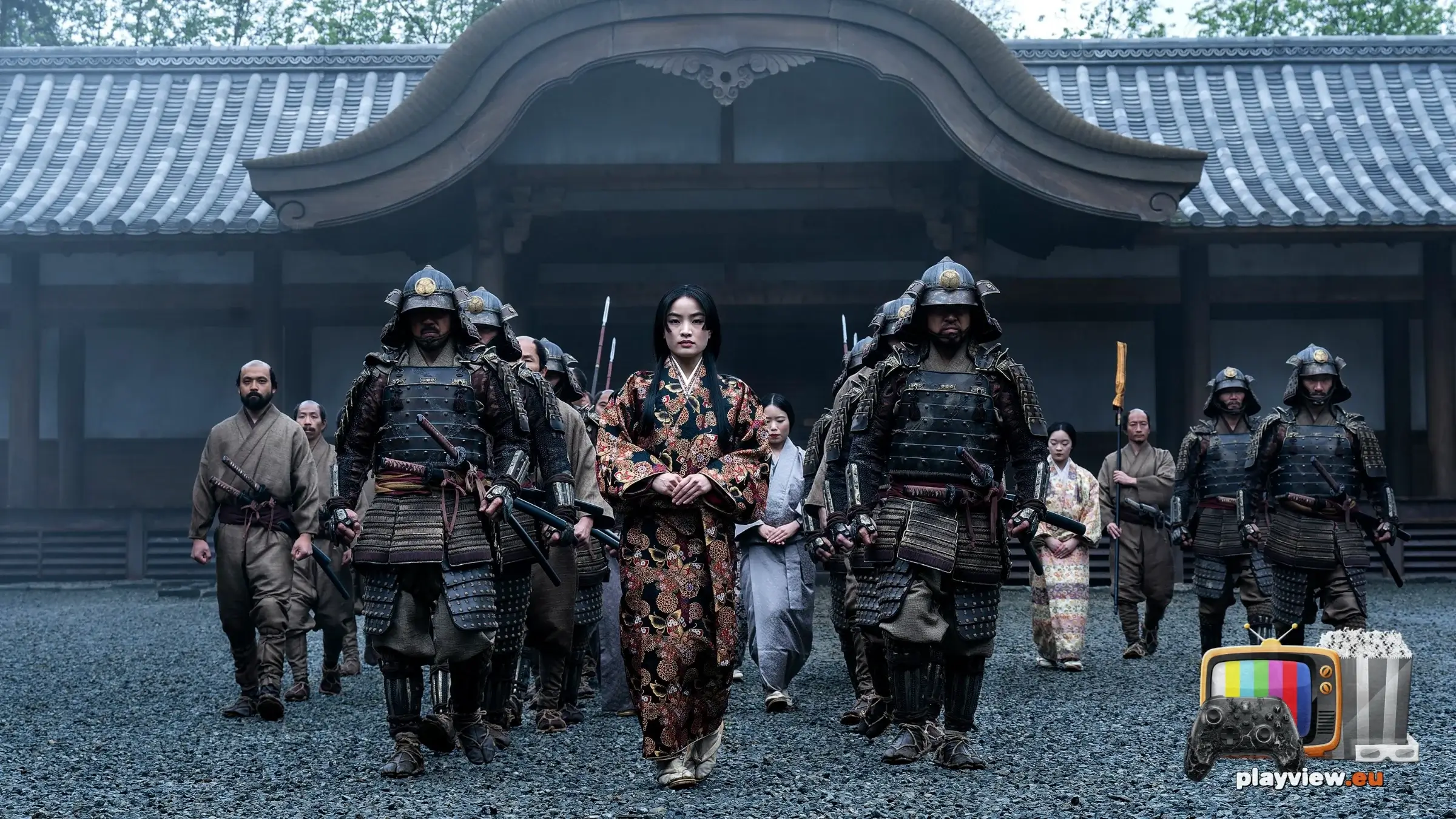
And then he meets Toda Mariko, who essentially becomes the bridge between Blackthorne and the world he has found himself in. (goddess to me Mariko) is one of the characters that make Shōgunmuch more interesting than a simple story of political intrigue, because in it almost all the contradictions of the time coexist. She is a woman of an important family, a samurai wife, a Christian, a translator and at the same time the daughter of a man whose actions have left an indelible mark on her and her family. Anna Sawai manages to play Mariko in a way that doesn't need exaggeration, because the character's strength lies more in control than explosion, and that's a perfect fit for a series where people rarely say what they really think out loud.
Her relationship with Blackthorne develops slowly and through their inability to communicate directly, which I personally find much more interesting than seeing yet another easy love story between two people from different worlds. Mariko is not just the woman who translates Blackthorne's words to the Japanese and the Japanese's words to him; she is the man who gradually translates an entire culture to him, explaining to him that behind a bow, a pause, or a particular word there may be a level of meaning that he could never perceive on his own.
And facing them is Hiroyuki Sanada's Toranaga, a character I feel is the true core of the entire series. Sanada doesn't play Toranaga like a classic TV "big bad" or like a general who has to prove in every scene how smart he is, but like a man who has realized that the greatest strength can be found in the ability to do nothing until the right time. Toranaga observes, lets his opponents think they've cornered him, even accepts humiliation when it serves his purpose, and waits until his opponents themselves create the conditions he needs.
This, after all, is the great game of Shōgun.. People talk about honor but think about survival, talk about loyalty while constantly considering which side will keep them alive, talk about duty while trying to protect their family, and often times tell the truth in a way that sounds like a lie because the entire society has learned to operate through layers and innuendo. Toranaga is simply the man who has learned to navigate this system better than anyone.
Honor, Bushidō, and a world that does not forgive weakness
The ShōgunI especially liked the way it uses the concept of honor, because it doesn't present it as a simple, romantic idea that exists to make samurai look heroic. In the world of the series honor comes at a real cost, and that cost can be your family, your position, your freedom, or ultimately your life itself. Seppuku isn't just a flashy ritual we've seen in countless movies; it's a way to control even how a man will die, so that his death has meaning for his lord, his family, or his own honor.
Buntaro is perhaps the harshest version of this logic, a man who seems to have left little space between himself and his duty, while Yabushige is almost at the opposite extreme. Tadanobu Asano gives Yabushige a strange balance between the comical, the ridiculous, the dangerous, and the downright human, because behind all his machinations is a man who understands that the world is changing and tries desperately to always be on the right side. In a series full of characters who talk about honor, Yabushige is the one who almost shamelessly admits that he wants to survive, and it's his inability to hide behind big ideas that ultimately makes him so interesting.
Mariko and the moment the whole story changes
As the season progresses, it becomes more and more apparent that Toranaga isn't necessarily looking for the big military conflict that everyone expects. When we get to Episode 9, Crimson Sky, his opponents believe that he is now in an extremely difficult position and that his next move will be a big war, but he chooses to use a very different weapon: Mariko. Fx herself confirms that Crimson Sky is the ninth episode and that the story of the episode revolves around Mariko's arrival in Osaka, her confrontation with Ishido, the shinobi, and her ultimate sacrifice.
Her mission to Osaka is essentially a political suicide mission, as she must confront Ishido and demand the release of the women and families of the great lords trapped in the city. Mariko knows very well that she may never leave, and so does Toranaga, but it is this knowledge that makes the mission so important. If Mariko dies, her death could create something that no army could create on its own: a political crisis that will force the people around Ishido to rethink where their loyalties really lie.
And there's one more detail in Crimson Skywhich shows how deeply the production has dug into the real story. The episode opens with Mariko pregnant and exiled to the snowy mountains, a story that directly alludes to the real Akechi Tama, known as Hosokawa Gracia, who was indeed confined to Midono after her father Akechi Mitsuhide rebelled. FX even explains that the historical Midono was in a mountainous area and that the snow could reach a very high height, which gives even more weight to Mariko's opening scene.
When Mariko dies in the explosion, the show doesn't just use her death for thrills. The entire political balance of Osaka shifts, the hostages are released, and Ishido's side loses a piece of the legitimacy it needed to continue the war. FX itself presents this particular development as the point where Mariko's tragic fate and Toranaga's political strategy meet.
And somewhere in there we understand that Mariko wasn't just someone Toranaga loved or trusted; she was part of his plan.
The ending: the battle we never saw
The big risk of the finale is that after ten episodes full of political tension, betrayals, deaths and war conflicts, the series decides not to give us the big payoff that almost any viewer would expect. We don't see the battle of Sekigahara, we don't see Toranaga crush Ishido, and we don't see his official rise to power. Instead, the sequence leaves us right before the battle, at a time when Toranaga has now managed to shape the conditions so that victory is almost inevitable.
This is no accident. The real Tokugawa Ieyasu won the Battle of Sekigahara on October 21, 1600, but the series is more interested in how the circumstances that made that victory possible were created than the battle itself. Ochiba does not offer Ishido the support of the heir's army, and thus his side loses a crucial piece of political legitimacy, while the finale leaves the viewer to understand that the real battle has already been decided at the level of political strategy.
Even the scene that initially seems to show an elderly Blackthorne in England works more as a dream and symbolism than an actual flash-forward. The image of an old man who has retained memories of Japan acts as a visual representation of the old Blackthorne who could return to England, while the man we met in the series has now changed so much that his true place is in Japan.
And then comes Toranaga's last big revelation to Yabushige. He explains to him that destroying Blackthorne's ship and sending Mariko to Osaka was part of a much larger plan, in which Toranaga didn't need to face all of his enemies at once, but to make them move in such a way that in the end they could no longer move against him. Mariko became the missing piece of the puzzle and Ishido found himself losing his political footing before he even had to face Toranaga on the battlefield.
And that to me is the real end of Shōgun. We don't see Toranaga become Shōgun because we don't need to. By that point we already know that the road to Sekigahara has been opened, and that the man who started the series trapped by his rivals has now created a game in which his rivals themselves have begun to play for him.
The real people behind the fiction
One of the things that makes Shōgun even more interesting when you know a bit of the story is that almost the entire basic political structure of the series it has real roots. Yoshii Toranaga is Tokugawa Ieyasu, Ishido is based on Ishida Mitsunari, John Blackthorne on the Englishman William Adams, Mariko on the Christian Hosokawa Gracia, and Ochiba on the Yodo-no-kata, while the conflict leading to Sekigahara forms the great historical basis on which James Clavell built his novel. FX themselves have created an entire story guide for the characters, showing the actual historical correspondences behind the main protagonists.
The series of course does not try to present all of this as a documentary and makes many changes to serve the drama, but the fact that the creators decided to go so deep into the historical and cultural side of the period can be seen in almost every scene. Even the language of the characters is treated as an element of the story rather than a mere tool for the viewer to understand the plot, which greatly helps to feel that you are watching a real culture and not just a set created for the needs of a series.
The production was much bigger than an expensive period set
One of the things that shows on screen is the huge effort that went into making the series not look like a western production that just put on Japanese costumes and put some castles in the background. Filming took place primarily in British Columbia, Canada, where entire environments were created to represent Japan in the 1600s, while Hiroyuki Sanada, in addition to starring, was also involved as a producer with a strong emphasis on cultural and historical accuracy. FX itself describes the production of the series as an attempt to recreate 1600s Japan in modern Vancouver, from palaces and villages to the smallest details of the objects found within the sets.
The level of detail in the costumes is a case in point. The entire production treated clothing not just as an aesthetic element but as part of the narrative, while collaboration with Japanese artists, performers and cultural consultants was a key part of the quest for authenticity. The series even went so far as to use masters of the Noh Theaterfrom Japan for the scenes of the sixth episode.
Even the visual effects are much more than the viewer probably realizes, as the VFX team reports more than 5,000 visual-effects shots to recreate feudal Japan. This is one of the factors that explain why many of the images in the series look almost like paintings, when in fact behind them there is a combination of real sets, props, costumes and digital work.
1980 and 2024: same story, different look
The comparison with Shōgunof 1980 is inevitable, mainly because that series left such a big mark on television. The NBC production starring Richard Chamberlain and Toshiro Mifune was a huge event for its time and proved that a story set in feudal Japan could become a massive television hit in the West. More than 120 million people watched the series in the United States, about one in three television viewers in the country at the time, and the production received 14 Emmy nominations and won three awards, including Outstanding Limited Series.
The biggest difference between the two productions, however, is not in effects, money or the technical capabilities that television has acquired over four decades. It is in the perspective from which they decide to tell the story.
The 1980 series is much more Blackthorne's story, with the Western viewer entering Japan with him and discovering that particular culture through their own ignorance and surprise. Richard Chamberlain is clearly the center of the narrative, and Toshiro Mifune acts as the massive Japanese presence opposite him, at a time when an American television production giving so much space to Japanese characters was itself unusual.
In 2024 the balance shifts significantly. Blackthorne remains an important character, but Mariko, Toranaga, Ochiba, and Ishido take on much more dramatic weight, and Japan itself ceases to function simply as "the unknown world" to be explained to the Western protagonist. The new series allows the viewer to remain for long periods outside of Blackthorne's perspective, to follow the Japanese characters when he is not even on the scene, and to understand that the real story continues regardless of the foreigner who has just arrived in the country.
This is also why the new series feels more like looking at the same story from the other side. Blackthorne is no longer the man through whom we must understand everything; he is a man who must himself learn to understand others.
And there is yet another important difference. In 1980 the series was a huge television production of its time, but the narrative language itself was necessarily closer to the model of a major American television miniseries. In 2024, filmmakers have the ability to let silence work, keep entire scenes in Japanese, not have to explain every cultural detail, and require the viewer to watch carefully. This makes the new series slower in places, but at the same time much closer to the feeling of actually being in a foreign culture.
What critics have said
Critical reception has been extremely positive. Shōgun scored 99% on Rotten Tomatoes and 85/100 on Metacritic, while the series ultimately made an even bigger impact at the awards, winning 18 Emmys, a performance that set a series record for one season, with Hiroyuki Sanada becoming the first Japanese actor to win an Emmy for Best Actor in a Drama Series and Anna Sawai the first actress of Asian descent to win the corresponding award for Best Actress.
What I love most about looking at the show's reception is that the critics didn't stop at "it's gorgeous." The production design, costumes and cinematography of course got a lot of praise, but just as important was the recognition of the work of the actors and the way the series managed to create tension without constantly having to resort to action. The series also received major accolades from SAG, WGA, DGA, PGA, TCA and other associations, indicating that its reception was not limited to television critics.
There were of course more reservations, mainly surrounding Blackthorne and his relationship with Mariko, as some critics felt that the show's political story was so strong that Blackthorne's personal journey felt underdeveloped in some places. There was also the expected backlash from those who expected a series building over ten episodes towards a civil war to finally give them a huge battle. But for me, it is precisely this choice that makes the ending so interesting.
And now comes the second season
Here is something that when we write a My View today it is definitely worth mentioning, because the second season will not be just a transfer of the next part of James Clavell's book. FX has officially announced that Rachel Kondo and Justin Marks have created an entirely new chapter, as the first season had already finished adapting the novel. And the most important thing is that the story will be transferred ten years after the events of the first season.
This means we're not talking about a simple sequel that picks up right where the last episode left off, with Toranaga marching towards Sekigahara. We will see characters that have now aged, a Japan that has changed and most importantly a Toranaga who, from what we have seen so far, will have already turned his survival into power. Hiroyuki Sanada naturally returns as Toranaga, Cosmo Jarvis as Blackthorne, and FX has already announced several new characters and actors, including Asami Mizukawa, Masataka Kubota, Sho Kaneta, Takaaki Enoki, and Jun Kunimura.
As of March 2026, five more cast additions had been announced, while FX has not revealed specific details about their roles or the plot other than that the story is set over a decade after the first season and continues the historically inspired story of Toranaga and Blackthorne.
And that personally makes me even more curious about what we'll see. Because the end of the first season was essentially the end of Toranaga's rise, while the second should show us what it means to live in the power you've worked so hard to gain. The man who patiently waited for the right moment in the first season will now be ten years older and faced with a completely different problem: not how to survive, but how to keep what he's won.
Shōgun ended up not being the series I expected to see when I started, and I mean that in a good way. You go in expecting a big story about samurai, wars, katanas and the rise of a great warlord, and gradually you realize that the series is much more interested in what happens before the battle, how alliances are formed, how a man can manipulate the political situation without having to fight a single battle, and how different the meaning of honor can be when it is not just a personal virtue but the whole way you have learned to perceive him world.
And therein lies the great success of the series for me. Toranaga is interesting not because he is the strongest warrior, but because he understands that a real war is not always decided by the man with the longest sword. It can be judged by a woman who will enter a castle knowing she may never come out, by a letter we will never see written in front of the camera, or by someone's decision not to send in their army when everyone expects them to. This is what makes Toranaga so special as a character: he doesn't need to win the battle to win the war, because he's already managed to make his opponents lose their options.
Mariko is the heart of this story, Toranaga is her mind, and Blackthorne is our eyes into a world we don't understand at first. Yabushige is perhaps the reminder that behind all the big words about honor, duty, and loyalty there are ultimately people who fear death and want to live, and that's exactly why his own path has so much value in a story where almost everyone else is ready to die for something bigger than themselves.
And maybe that's what makes the series work so well for someone who loves samurai history. He doesn't try to present them as mythical superheroes with swords. It presents them as people of a certain world, where honor could truly determine your life and death, and where your personal desire was often far less important than duty to family, lord, and society.
The samurai may have disappeared as a military class and the katana may have ceased to be the weapon that would determine the outcome of a battle, but their image, the idea of their discipline and above all the concept that a man's honor can be more important than his own life continued to survive long after the end of their era. a World of Warcraft Guild named Samurai until that trip to Japan for the 2008 Tokyo Game Show where I brought an actual Daishō with me. It's not the sword itself that fascinates me the most, but the story it carries with it and the world it represents.
So Shōgun doesn't need to show us Sekigahara to complete its story. It shows us the man who made it that far, the man who understood that the greatest victory is not always the one won on a battlefield, but the one already decided before the armies even reach each other.
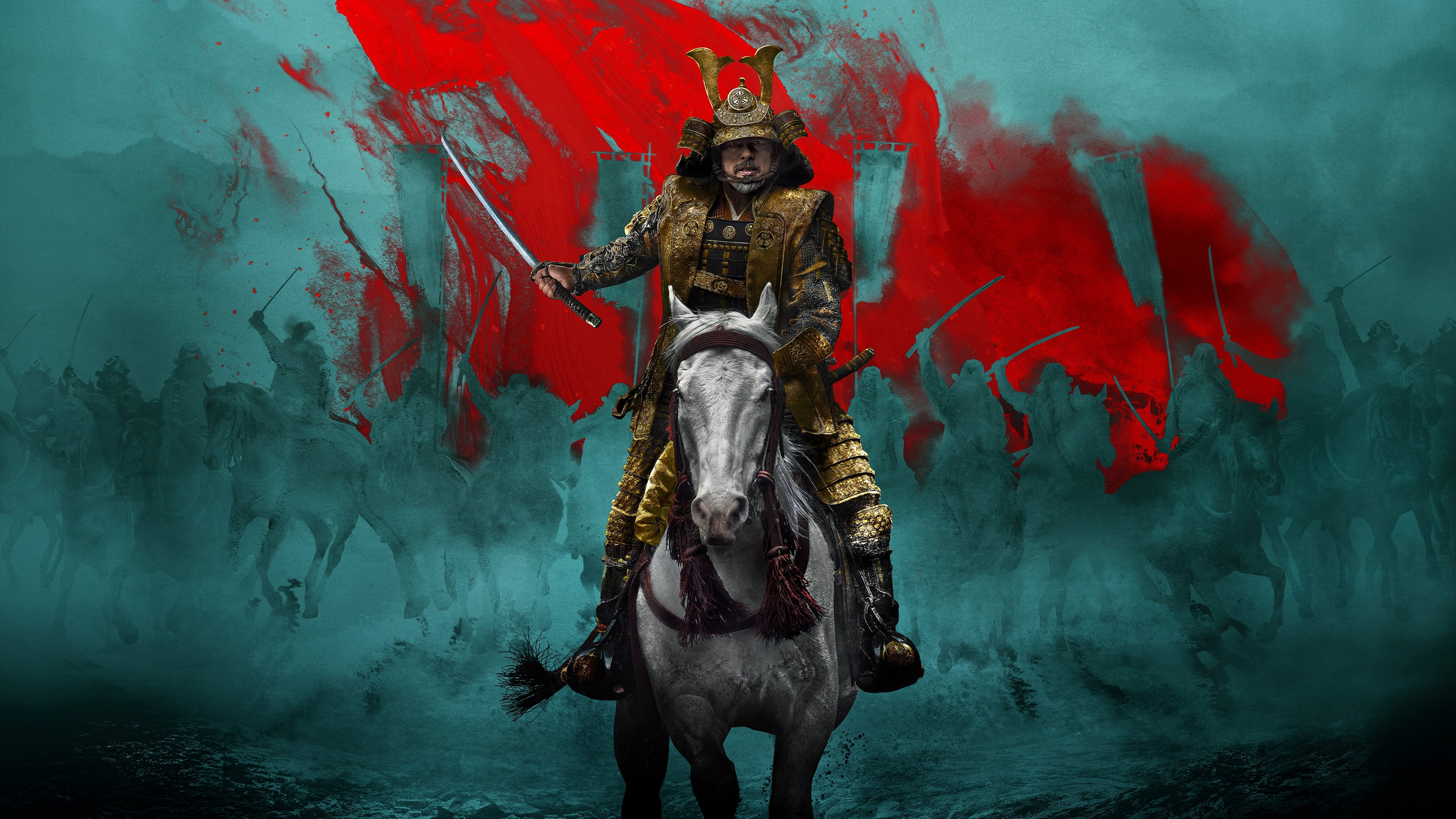
And perhaps the most defining image of the entire first season is just this: Toranaga looking ahead, knowing that the war is essentially already decided, while we will never see the sword come down.
Why the greatest Shōgun samurai doesn't win when he draws the sword.
He wins because he managed not to have to draw it.


