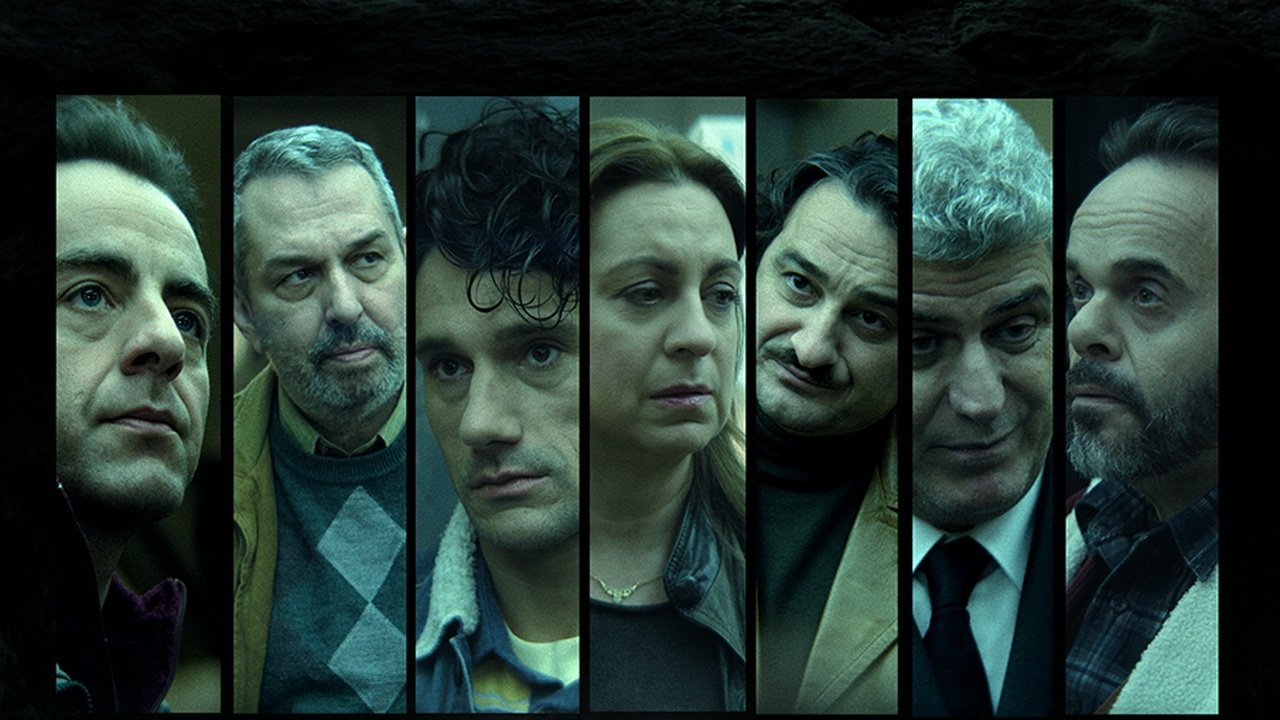
The biggest heist that ever happened in Greece, on our screens!

Perhaps one of the best Greek series I have watched in recent years. And the strange thing is that we are talking about a story whose ending we already know. We know the robbery will happen. We know the safety deposit boxes will be emptied. We know the people who planned it will never be arrested. And yet, “Rififi” by Sotiris Tsafoulias manages to keep you hooked until the very last minute.
Perhaps one of the best Greek series I have watched in recent years. And the strange thing is that we are talking about a story whose ending we already know. We know the robbery will happen. We know the safety deposit boxes will be emptied. We know the people who planned it will never be arrested. And yet, “Rififi” by Sotiris Tsafoulias manages to keep you hooked until the very last minute.
Tsafoulias, whom we came to love through “Eteros Ego” and “14 Klistes,” takes one of the most famous unsolved crimes in modern Greek history and does not simply try to turn it into a Greek version of La Casa de Papel. The series is inspired by the real 1992 robbery of the Bank of Work, but it is not a reconstruction of the real perpetrators or the actual events. Tsafoulias himself has made it clear that this is a work of fiction inspired by the case.
And that ultimately becomes its greatest strength.
Because the robbery is almost the excuse. The real interest lies in the people behind it. Seven people, seven different lives, seven different losses. People who do not begin the story as professional criminals. They are people who have been pushed so far by life, financial reality, personal losses and a system they feel has abandoned them that, at some point, they decide to do something that once seemed unthinkable.
And somewhere along the way, something very clever happens. From the beginning, you find yourself on their side.
Not because what they are doing is right. But because you get to know them as people first.
Olga — Evaggelia Moumouri
Olga is the mastermind.
A 45-year-old EYDAP employee, quiet, measured and almost frozen on the outside, she carries a loss that has destroyed her life. She does not want the bank's money. She wants to hurt the bank itself.
The series gradually reveals that behind her obsession lies the loss of her child and a personal story that forms the second real-life event on which the fiction was built.
And this is perhaps the biggest risk of “Rififi.” Olga is not presented simply as a heroine we are supposed to sympathize with. She is determined, manipulative when necessary and completely committed to her goal. What drives her, however, is not greed. It is revenge.
Evangelia Moumouri is excellent. And as the episodes go by, you realize that much of her performance is built around what she does not say.
Manolis — Hristos Hatzipanagiotis
Manolis is the man who keeps the balance. In his fifties, an old friend and business partner of Olga's husband, he sees his own life collapsing along with the garage they used to run.
He is perhaps the most practical person in the group. He knows that the others are people who have reached their limits and tries to keep both the plan and the people together. He is the strategic mind next to Olga and, at the same time, the person who understands better than anyone how dangerous what they are about to do really is.
Christos Hatzipanagiotis gives the character a grounded quality that fits the series perfectly. There is also a great piece of trivia from the production: he has said that he had to overcome his claustrophobia for the scenes inside the tunnel.
Nikos — Vassilis Haralambopoulos
Nikos is one of the most tragic members of the group.
A former graphic designer who now works as a painter, he is drowning in grief following the death of his wife from heart disease. He has lost his job, his will to live and essentially his belief that there is anything waiting for him ahead.
For Nikos, the robbery becomes one last gamble. A chance to feel that he is part of something again, that he has a purpose, that he can do something that matters.
And this is where Charalampopoulos does something I really liked. He does not play “the depressed man.” He plays a man who has almost emptied himself from the inside. The difference is enormous.
Vakis — Panos Vlahos
Vakis is the most impulsive member of the group.
Thirty-five years old, with the permanent energy of an eternal teenager, he loves motorcycles and lives with his father and his disabled sister, Elli. His family is in danger of losing their home and the bank has become yet another enemy standing in his way.
He is the character who most resembles what you would expect to see in a traditional heist series. The nervous, unpredictable guy who could potentially blow the whole plan apart.
And Panos Vlahos plays him in a way that makes him both irritating and likeable.
One of the strangest pieces of trivia from the production is that, in the scene where Vakis is buried under the soil, Vlahos actually held his breath until they dug him out.
Michalis — Prometheus Aleiferopoulos
Michalis is an auto electrician and one of the most human characters in the group.
His life has gone off the rails. In a moment of rage, he drove his car into a bank and ended up in prison. His wife has left him and taken their children with her, while the only real connection he has left is his sick father.
Olga finds him in prison and offers him something that is not simply money. She offers him a chance to rebuild his life.
And that makes Michalis perhaps one of the easiest characters to understand. He is not looking for adventure. He is looking for one last chance.
Antonis — Vladimiros Kiriakidis
Antonis is one of the characters who gives the series its humor without ever undermining the drama.
He works at a funeral home and is a big, kind-hearted man with a childlike soul. He is Argyris' best friend and essentially never abandons him. As part of the plan, he is involved in the tunnel excavation.
His relationship with Argyris is one of the most beautiful in the series because it is not based on pity. Antonis does not see his friend as “different.” He sees him as his friend.
And that is much more powerful than any big social message.
Argyris — Dimos Gigantakis
Argyris is perhaps the most unusual person in the group.
Around 45, small in stature, extremely intelligent, a former petty thief and exceptionally capable of fitting into places where others cannot, he has grown up learning how to survive in a world that constantly reminds him that he is different.
He works alongside Antonis and is not in a good financial situation. His attention to detail and ability to move through difficult spaces eventually become crucial elements of the plan.
And here comes one of the most unbelievable pieces of trivia in the entire series.
Dimos Gigantakis himself was brought in for questioning by the Security Police in 1993, one year after the real robbery, because authorities were investigating the possibility that a small person had been used during the break-in. He had an unshakable alibi and, of course, had absolutely nothing to do with the crime. When Tsafoulias learned the real story, he incorporated it into Argyris' character.
That is one of those things that, if someone wrote it into a script, you would say they had gone too far.
And yet, it really happened.
And then there is Themis
Themis, played by Achileas Zervas, is not one of the seven main robbers, but he plays an important role in the story.
He is the waiter at the pastry shop across from the bank. A man most people ignore and underestimate. He essentially becomes the group's informant and helps Olga because he too finds in the whole operation a way to respond to the humiliation he experiences every day.
And that is another thing I particularly liked about “Rififi”: almost every person who passes through the story carries their own small injustice.
The real robbery
And this is where fiction meets reality.
On December 19–20, 1992, at the Bank of Work on 19 Kallirrois Street, unknown perpetrators dug an underground tunnel approximately 23–25 meters long beneath Kallirrois Street, starting from the bed of the Ilissos River. The tunnel had supports, lighting and even rails for transporting the excavated material.
On Monday, December 21, employees discovered that 301 of the 1,151 safety deposit boxes had been broken into.
The loot was estimated at approximately 5 billion drachmas, an amount often converted in modern reports to roughly €15 million.
But the most astonishing part was not only the amount.
It was that nobody noticed anything.
The perpetrators had worked for a considerable period beneath one of Athens' busiest central roads without being detected.
And the best part?
We never found out who they were.
There was, of course, a major twist in 1994, when a Syrian prisoner named Jumah Khalid claimed that he had participated in the robbery and named a total of 17 people. Among them were the bank's deputy director, a postal employee and businessmen. Some were arrested and held in custody, but Khalid later withdrew his accusations and in 1995 the Appeals Council cleared all the accused. The case ultimately remained unsolved.
So yes. At its core, the “Robbery of the Century” remains a robbery without known perpetrators.
And this is where Tsafoulias comes in
The greatest achievement of the series is that it does not try to answer the question, “Who were the real robbers?”
He created his own.
And he made them human.
That is also why comparisons with La Casa de Papel are inevitable but ultimately a little unfair. Yes, there is a team, a plan, preparation, a tunnel, the police, a countdown and a robbery that seems impossible to pull off.
But “Rififi” is much more interested in what happened before they entered the tunnel.
The robbery is the result.
Their lives are the story.
And you can see that even in the structure of the series. The narrative moves back and forth, using flash-forward sequences after the robbery and gradually returning to the lives of the characters. So while we know the plan will succeed, we do not know exactly what brought each of them there.
The script by Vassilis Risvas and Dimitra Sakali does not rush to explain the characters. It allows them to reveal themselves.
And Tsafoulias' direction has that cinematic quality we now expect from him. Greece in the early '90s, the aesthetics, the locations, the cars, the clothes, the offices, the garage, the pastry shop, the underground. Everything works as part of the puzzle.
There is even a great production detail: the tunnel we see in the series was not filmed in one continuous location. The production used four different locations and combined them in editing to make them look like one continuous underground network.
The big revelation
And then there is Olga.
Up to that point, you may think you are watching a very good Greek heist series. By the end, however, you realize that the robbery was essentially a means of telling a much heavier story.
Olga's story is rooted in the real-life tragedy of little Panagiotis Vasilellis, a child from Lesbos who battled cancer and whose family tried to secure treatment abroad. The series does not reproduce the real story directly, but takes key elements of that tragedy and transforms them into the dramatic core of Olga's character.
And then you understand why Olga keeps returning to the same pastry shop and ordering the same pastry.
Every time, she takes only one bite.
One.
Until the end.
SPOILER — The Ending
And this is where “Rififi” does something that I personally find much more powerful than a big crime-series finale.
It does not end with the robbers celebrating.
It does not end with the police catching them.
It does not end with some huge revelation about where the money went.
It ends with Olga.
The robbery has succeeded. The group has managed to accomplish what seemed impossible. The bank has been hit and Olga has obtained what she considers her revenge.
“We didn't commit the robbery of the century. We took the revenge of the century.”
And then the series returns to where the real heart of the story has always been.
Her child.
The final scene takes us back to the tragedy that shaped Olga. Her child is in the hospital, in the final moments of his life. And then we finally understand why the pastry was so important.
Her child wanted something sweet. He had only managed to eat one bite.
And Olga, throughout the series, could never finish her own pastry.
Until the final episode.
There, for the first time, she eats the entire thing.
It is a tiny gesture that suddenly carries enormous weight.
Because Olga may have won her revenge.
She never got her child back.
And that is the great irony of “Rififi.” For six episodes, we watch a group of people trying to break through a wall. In the end, we realize that the real wall was never the one surrounding the bank.
It was the one grief had built inside Olga.
Evangelia Moumouri needs almost nothing in the finale. The look, the silence, the pastry and the moment she collapses beside her child do all the work. And it is no coincidence that this particular scene became the moment discussed most by audiences after the series ended.
What I liked most about “Rififi” is that it did not make me care about whether the robbery would happen.
It made me care about whether these people would ever be able to rebuild their lives.
And that is difficult when you have a story based on a real event whose outcome we already know.
Sotiris Tsafoulias and Vassilis Risvas–Dimitra Sakali handle that problem intelligently. They do not try to manufacture suspense where there is none. They create suspense around the people.
Will Michalis manage to see his children again?
Will Nikos find some meaning in life again?
Will Vakis protect his family?
Will Manolis keep the group together?
Will Argyris finally prove that he matters?
And ultimately, will Olga ever find what she is really looking for?
The answer to that last question is the entire series.
No.
Because there are losses that cannot be undone.
And there are acts of revenge that can win a battle without ever winning the war.
“Rififi” begins as a story about a robbery that became part of Greek history.
It ends as a story about seven people who, at some point, felt that life itself had robbed them.
And perhaps that is why, even though you know from the very beginning that they will never be caught, you do not want it to end.
Because by the time the credits roll, you are no longer watching the robbers.
You are watching people.
And for me, that is what makes “Rififi” one of the most complete Greek series we have seen in recent years.
“Rififi” begins as a story about a robbery that became part of Greek history.
It ends as a story about seven people who, at some point, felt that life itself had robbed them.
And perhaps that is why, even though you know from the very beginning that they will never be caught, you do not want it to end.
Because by the time the credits roll, you are no longer watching the robbers.
You are watching people.


